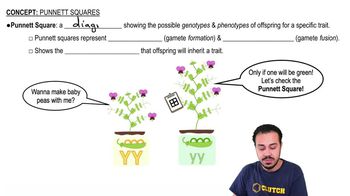
A pea plant heterozygous for inflated pods (Ii) is crossed with a plant homozygous for constricted pods (ii). Draw a Punnett square for this cross to predict genotypic and phenotypic ratios. Assume that pollen comes from the ii plant.
A man with type A blood marries a woman with type B blood. Their child has type O blood. What are the genotypes of these three individuals? What genotypes, and in what frequencies, would you expect in future offspring from this marriage?
Verified step by step guidance
Verified video answer for a similar problem:
Key Concepts
Blood Type Genetics
Punnett Square
Mendelian Inheritance
A man has six fingers on each hand and six toes on each foot. His wife and their daughter have the normal number of digits. Remember that extra digits is a dominant trait. What fraction of this couple's children would be expected to have extra digits?
Two pea plants heterozygous for the characters of pod color and pod shape are crossed. Draw a Punnett square to determine the phenotypic ratios of the offspring.
Flower position, stem length, and seed shape are three characters that Mendel studied. Each is controlled by an independently assorting gene and has dominant and recessive expression as indicated in Table 14.1.
If a plant that is heterozygous for all three characters is allowed to self-fertilize, what proportion of the offspring would you expect to be each of the following? (Note: Use the rules of probability instead of a huge Punnett square.)
a. Homozygous for the three dominant traits
b. Homozygous for the three recessive traits
c. Heterozygous for all three characters
d. Homozygous for axial and tall, heterozygous for seed shape