Pearson+ LogoPearson+ Logo
Ch. 13 - Meiosis and Sexual Life Cycles
Campbell - Campbell Biology 12th Edition
Urry12th EditionCampbell BiologyISBN: 9785794169850Not the one you use?Change textbook
Chapter 13, Problem 7

Assume that genes A and B are on the same chromosome and are 50 map units apart. An animal heterozygous at both loci is crossed with one that is homozygous recessive at both loci. What percentage of the offspring will show recombinant phenotypes resulting from crossovers? Without knowing these genes are on the same chromosome, how would you interpret the results of this cross?

Verified step by step guidance
1
Understand the concept of map units and linkage: Map units, or centimorgans, measure the distance between genes on a chromosome based on the frequency of recombination between them. A distance of 50 map units suggests a 50% recombination frequency, which is typically observed for genes on different chromosomes or very far apart on the same chromosome.
Analyze the cross: The cross is between a heterozygous individual (AaBb) and a homozygous recessive individual (aabb). Since the genes are 50 map units apart, they behave as if they are independently assorting.
Calculate the expected recombinant offspring: With a recombination frequency of 50%, half of the gametes from the heterozygous parent (AaBb) will be recombinant. When crossed with the homozygous recessive (aabb), 50% of the offspring will display recombinant phenotypes (Aabb and aaBb).
Interpretation without linkage knowledge: Without knowing the genes are on the same chromosome, one might incorrectly assume that the genes assort independently due to their 50% recombination frequency, which mimics the expected outcome of genes on different chromosomes or very far apart on the same chromosome.
Conclusion: The results of this cross, showing 50% recombinant phenotypes, align with the expectation for genes that are either unlinked or very distantly linked on the same chromosome. This demonstrates the importance of understanding genetic linkage and recombination in predicting and interpreting genetic crosses.

Verified video answer for a similar problem:

This video solution was recommended by our tutors as helpful for the problem above.
Video duration:
4m
Was this helpful?

Key Concepts

Here are the essential concepts you must grasp in order to answer the question correctly.

Genetic Linkage

Genetic linkage refers to the tendency of genes located close to each other on the same chromosome to be inherited together during meiosis. When genes are linked, they do not assort independently, which affects the ratios of phenotypes in offspring. In this case, genes A and B are 50 map units apart, indicating they are on the same chromosome but far enough apart to allow for recombination.
Recommended video:

Recombination Frequency

Recombination frequency is the proportion of offspring that exhibit recombinant phenotypes due to crossing over during meiosis. It is measured in map units, where 1 map unit corresponds to a 1% chance of recombination. Since genes A and B are 50 map units apart, the expected recombination frequency is 50%, meaning that half of the offspring will show recombinant phenotypes.
Recommended video:
06:36
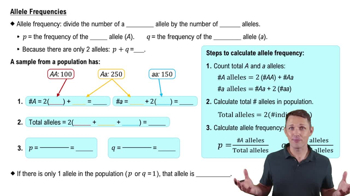
Allele Frequencies

Mendelian Inheritance

Mendelian inheritance describes the patterns of inheritance for traits controlled by single genes, as established by Gregor Mendel's laws. In the context of this cross, if the genes were not known to be linked, one might expect a 1:1:1:1 ratio of phenotypes in the offspring, reflecting independent assortment. However, the presence of linkage alters this expectation, leading to a different distribution of phenotypes.
Recommended video:
Guided course
02:27
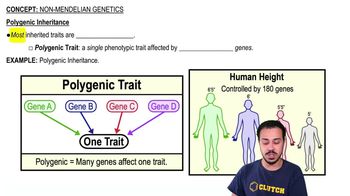
Polygenic Inheritance