Pearson+ LogoPearson+ Logo
Ch. 6 - Cancer
Belk, Maier - Biology: Science for Life 6th Edition
Belk, Maier6th EditionBiology: Science for LifeISBN: 9780135214084Not the one you use?Change textbook
Chapter 6, Problem 6

At metaphase of mitosis, ________.
a. The chromosomes are condensed and found at the poles.
b. The chromosomes are composed of one sister chromatid.
c. Cytokinesis begins.
d. The chromosomes are composed of two sister chromatids and are lined up along the equator of the cell.

Verified step by step guidance
1
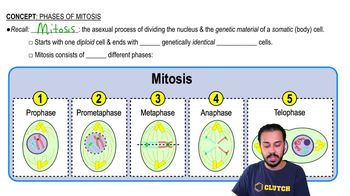
Understand the context of the question: Metaphase is a stage in mitosis, which is the process of cell division that ensures each daughter cell receives an identical set of chromosomes.
Recall the key events of metaphase: During this stage, chromosomes are fully condensed and align at the metaphase plate (the equator of the cell). This alignment ensures proper segregation during the next phase, anaphase.
Review the structure of chromosomes at metaphase: Each chromosome at this stage consists of two sister chromatids, which are identical copies of DNA held together by a centromere.
Eliminate incorrect options: a) Chromosomes are not at the poles during metaphase; they are at the equator. b) Chromosomes are not composed of one sister chromatid; they still have two. c) Cytokinesis does not begin during metaphase; it occurs later, typically during telophase or after.
Select the correct answer: The correct description of metaphase is that the chromosomes are composed of two sister chromatids and are lined up along the equator of the cell.

Verified video answer for a similar problem:

This video solution was recommended by our tutors as helpful for the problem above.
Video duration:
52s
Was this helpful?

Key Concepts

Here are the essential concepts you must grasp in order to answer the question correctly.

Mitosis

Mitosis is the process of cell division that results in two genetically identical daughter cells. It consists of several stages: prophase, metaphase, anaphase, and telophase. During metaphase, chromosomes align at the cell's equatorial plane, ensuring that each daughter cell will receive an identical set of chromosomes.
Recommended video:
Guided course
03:21
Phases of Mitosis

Chromatids

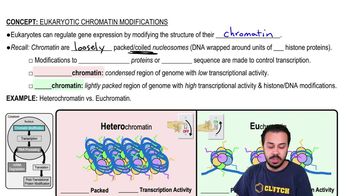
Chromatids are the two identical halves of a replicated chromosome, joined together at a region called the centromere. During metaphase, each chromosome consists of two sister chromatids, which are crucial for accurate segregation during cell division. This ensures that each daughter cell receives the correct number of chromosomes.
Recommended video:
Guided course
03:56
Eukaryotic Chromatin Modifications

Cytokinesis

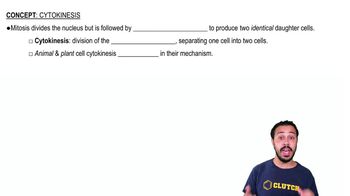
Cytokinesis is the final step of cell division, occurring after mitosis, where the cytoplasm of a parental cell is divided into two daughter cells. It typically begins during anaphase or telophase and involves the formation of a cleavage furrow in animal cells or a cell plate in plant cells. This process is essential for the physical separation of the two new cells.
Recommended video: