Pearson+ LogoPearson+ Logo
Ch. 6 - Cancer
Belk, Maier - Biology: Science for Life 6th Edition
Belk, Maier6th EditionBiology: Science for LifeISBN: 9780135214084Not the one you use?Change textbook
Chapter 6, Problem 3

A cell that begins mitosis with 46 chromosomes produces daughter cells with ________ chromosomes.
a. 13
b. 23
c. 46
d. 92

Verified step by step guidance
1
Understand the process of mitosis: Mitosis is a type of cell division that results in two daughter cells, each with the same number of chromosomes as the parent cell. It is essential for growth, repair, and asexual reproduction in multicellular organisms.
Recall the chromosome number in human cells: Human somatic (body) cells are diploid, meaning they contain two sets of chromosomes (one from each parent). This totals 46 chromosomes in a typical human cell.
Analyze what happens during mitosis: During mitosis, the parent cell duplicates its chromosomes during the S phase of the cell cycle, resulting in 92 chromatids. However, these chromatids are divided equally between the two daughter cells during the mitotic phase.
Determine the chromosome number in daughter cells: After mitosis, each daughter cell receives one complete set of chromosomes, which is identical to the parent cell. Therefore, each daughter cell will have 46 chromosomes.
Match the correct answer to the options provided: Based on the explanation, the correct answer is c. 46 chromosomes.

Verified video answer for a similar problem:

This video solution was recommended by our tutors as helpful for the problem above.
Video duration:
24s
Was this helpful?

Key Concepts

Here are the essential concepts you must grasp in order to answer the question correctly.

Mitosis

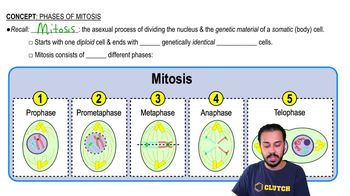
Mitosis is a type of cell division that results in two genetically identical daughter cells, each with the same number of chromosomes as the original cell. In humans, somatic cells undergo mitosis to maintain the diploid number of chromosomes, which is 46. This process is crucial for growth, repair, and asexual reproduction.
Recommended video:
Guided course
03:21
Phases of Mitosis

Chromosome Number

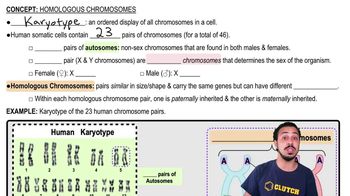
Chromosomes are structures within cells that contain DNA and genetic information. In humans, normal somatic cells have 46 chromosomes, arranged in 23 pairs. During mitosis, the chromosome number remains constant, ensuring that each daughter cell receives the same diploid number of chromosomes as the parent cell.
Recommended video:
Guided course
08:09
Homologous Chromosomes

Daughter Cells

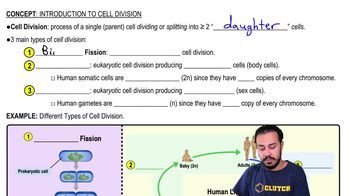
Daughter cells are the two new cells that result from the division of a parent cell during mitosis. Each daughter cell inherits an identical set of chromosomes, maintaining the original chromosome number. In the case of a cell starting with 46 chromosomes, each daughter cell will also have 46 chromosomes after mitosis.
Recommended video:
Guided course
09:40
Introduction to Cell Division