Pearson+ LogoPearson+ Logo
Ch. 5 - Life in the Greenhouse
Belk, Maier - Biology: Science for Life 6th Edition
Belk, Maier6th EditionBiology: Science for LifeISBN: 9780135214084Not the one you use?Change textbook
Chapter 5, Problem 3

Water has a high heat-absorbing capacity because ________.
a. The sun's rays penetrate to the bottom of bodies of water, mainly heating the bottom surface.
b. The strong covalent bonds that hold individual water molecules together require large inputs of heat to break.
c. It has the ability to dissolve many heat-resistant solutes.
d. Initial energy inputs are first used to break hydrogen bonds between water molecules and only after these are broken, to raise the temperature; e. all of the above are true.

Verified step by step guidance
1
Step 1: Understand the concept of water's high heat-absorbing capacity. This property is due to water's ability to absorb and store large amounts of heat energy without a significant change in temperature. This is primarily due to the hydrogen bonds between water molecules.
Step 2: Analyze the options provided in the question. Each option suggests a reason for water's high heat-absorbing capacity. Evaluate each one based on your understanding of water's molecular properties.
Step 3: Recall that hydrogen bonds between water molecules play a critical role in water's heat capacity. When heat is applied, the energy is first used to break these hydrogen bonds before increasing the kinetic energy (temperature) of the water molecules.
Step 4: Eliminate incorrect options. For example, strong covalent bonds within individual water molecules (option b) are not responsible for heat absorption, as these bonds are not broken during normal heating. Similarly, the sun's rays heating the bottom of water bodies (option a) is unrelated to water's intrinsic heat capacity.
Step 5: Identify the correct answer based on the explanation. The correct reason is that initial energy inputs are used to break hydrogen bonds between water molecules (option d). This explains why water has a high heat-absorbing capacity.

Verified video answer for a similar problem:

This video solution was recommended by our tutors as helpful for the problem above.
Video duration:
1m
Was this helpful?

Key Concepts

Here are the essential concepts you must grasp in order to answer the question correctly.

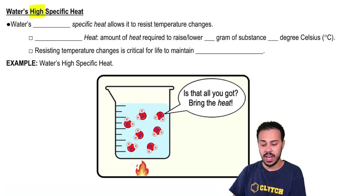
Heat Capacity

Heat capacity is the amount of heat energy required to change the temperature of a substance by a given amount. Water has a high heat capacity, meaning it can absorb a significant amount of heat without a large increase in temperature. This property is crucial for regulating temperatures in natural environments and is vital for maintaining homeostasis in living organisms.
Recommended video:
Guided course
03:25
Water’s High Specific Heat

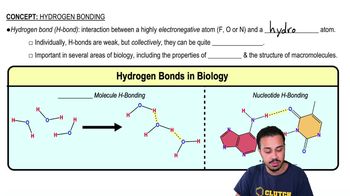
Hydrogen Bonds

Hydrogen bonds are weak attractions that occur between the hydrogen atom of one water molecule and the oxygen atom of another. These bonds are responsible for many of water's unique properties, including its high heat capacity. When heat is added to water, much of the energy is initially used to break these hydrogen bonds before the temperature of the water begins to rise.
Recommended video:
Guided course
05:03
Hydrogen Bonding

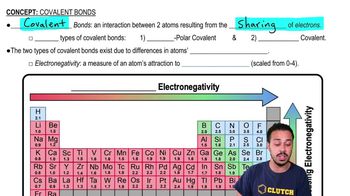
Covalent Bonds

Covalent bonds are strong chemical bonds formed when two atoms share electrons. In water, each molecule consists of two hydrogen atoms covalently bonded to one oxygen atom. While covalent bonds give water its molecular structure, it is the hydrogen bonds between water molecules that significantly contribute to its high heat-absorbing capacity.
Recommended video:
Guided course
04:28
Covalent Bonds