Pearson+ LogoPearson+ Logo
Ch. 5 - Life in the Greenhouse
Belk, Maier - Biology: Science for Life 6th Edition
Belk, Maier6th EditionBiology: Science for LifeISBN: 9780135214084Not the one you use?Change textbook
Chapter 5, Problem 9

Photorespiration occurs ________.
a. Under hot and dry conditions.
b. When oxygen is incorporated in the first step of the light-independent reactions.
c. When carbon dioxide levels are high inside the plant.
d. A and B are correct.
e. A, B, and C are correct.

Verified step by step guidance
1
Step 1: Begin by understanding the concept of photorespiration. Photorespiration is a process that occurs in plants when the enzyme RuBisCO incorporates oxygen (O₂) instead of carbon dioxide (CO₂) during the Calvin cycle, leading to a less efficient production of sugars.
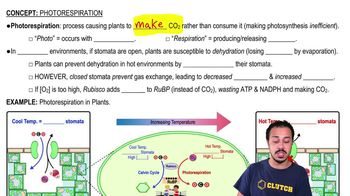
Step 2: Analyze the environmental conditions that favor photorespiration. Photorespiration typically occurs under hot and dry conditions because plants close their stomata to conserve water, reducing CO₂ levels and increasing O₂ levels inside the leaf.
Step 3: Examine the role of RuBisCO in photorespiration. RuBisCO can bind to either CO₂ or O₂. When CO₂ levels are low and O₂ levels are high, RuBisCO is more likely to incorporate O₂, initiating photorespiration.
Step 4: Evaluate the options provided in the question. Option (a) mentions hot and dry conditions, which are correct. Option (b) refers to oxygen being incorporated in the first step of the light-independent reactions, which is also correct. Option (c) mentions high CO₂ levels, which would actually reduce photorespiration, making it incorrect.
Step 5: Combine the correct options. Based on the analysis, both (a) and (b) are correct, making the correct answer 'd. A and B are correct.'

Verified video answer for a similar problem:

This video solution was recommended by our tutors as helpful for the problem above.
Video duration:
1m
Was this helpful?

Key Concepts

Here are the essential concepts you must grasp in order to answer the question correctly.

Photorespiration

Photorespiration is a metabolic process in plants that occurs when the enzyme RuBisCO fixes oxygen instead of carbon dioxide, leading to a wasteful pathway that reduces the efficiency of photosynthesis. This process is more likely to happen under conditions of high temperature and low carbon dioxide availability, which can occur during hot and dry weather.
Recommended video:
Guided course
14:32
Photorespiration

Light-Independent Reactions

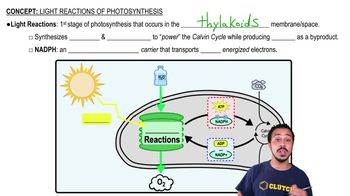
The light-independent reactions, also known as the Calvin cycle, are a series of biochemical reactions that occur in the stroma of chloroplasts, where carbon dioxide is fixed into organic molecules. While these reactions primarily utilize carbon dioxide, photorespiration can occur when oxygen is mistakenly incorporated, leading to a decrease in the overall efficiency of photosynthesis.
Recommended video:
Guided course
04:06
Light Reactions of Photosynthesis

Environmental Conditions Affecting Photosynthesis

Environmental factors such as temperature, humidity, and carbon dioxide concentration significantly influence the rate of photosynthesis and the occurrence of photorespiration. Under hot and dry conditions, stomata close to conserve water, which can lead to increased oxygen levels and decreased carbon dioxide levels inside the plant, promoting photorespiration.
Recommended video:
Guided course
10:15
Environmental Tonicity Affects Cells
Related Practice