Pearson+ LogoPearson+ Logo
Ch. 2 - Science Fiction, Bad Science, and Pseudoscience
Belk, Maier - Biology: Science for Life 6th Edition
Belk, Maier6th EditionBiology: Science for LifeISBN: 9780135214084Not the one you use?Change textbook
Chapter 2, Problem 6

Which of the following terms is least like the others?
a. Monosaccharide
b. Phospholipid
c. Fat
d. Steroid
e. Lipid

Verified step by step guidance
1
Step 1: Begin by understanding the terms provided in the question. Monosaccharide, phospholipid, fat, steroid, and lipid are all biological molecules, but they belong to different categories based on their structure and function.
Step 2: Define each term: A monosaccharide is a simple sugar and the basic unit of carbohydrates. Phospholipids, fats, and steroids are types of lipids, which are hydrophobic molecules primarily involved in energy storage, membrane structure, and signaling.
Step 3: Recognize the relationship between the terms. Phospholipids, fats, and steroids are all classified as lipids, while a monosaccharide is not a lipid but a carbohydrate.
Step 4: Identify the term that is least like the others. Since monosaccharides are carbohydrates and not lipids, they are structurally and functionally distinct from the other terms listed.
Step 5: Conclude that the term 'monosaccharide' is the least like the others because it belongs to a different category of biological molecules (carbohydrates) compared to the rest, which are lipids.

Verified video answer for a similar problem:

This video solution was recommended by our tutors as helpful for the problem above.
Video duration:
2m
Was this helpful?

Key Concepts

Here are the essential concepts you must grasp in order to answer the question correctly.

Monosaccharides

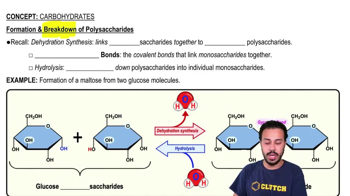
Monosaccharides are the simplest form of carbohydrates, consisting of single sugar molecules like glucose and fructose. They serve as fundamental building blocks for more complex carbohydrates and are primarily involved in energy production and storage in living organisms.
Recommended video:
Guided course
03:08
Formation & Breakdown of Polysaccharides

Lipids

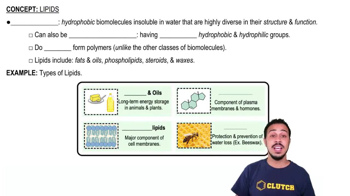
Lipids are a diverse group of hydrophobic organic molecules, including fats, phospholipids, and steroids. They play crucial roles in energy storage, cellular structure, and signaling. Unlike carbohydrates, lipids do not form polymers and are characterized by their insolubility in water.
Recommended video:

Phospholipids, Fats, and Steroids

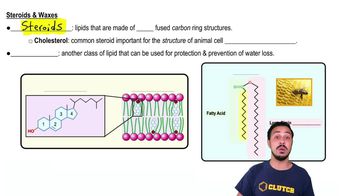
Phospholipids, fats, and steroids are all types of lipids. Phospholipids are key components of cell membranes, fats serve as long-term energy storage, and steroids function as hormones and signaling molecules. They share structural similarities, such as hydrophobic properties, distinguishing them from monosaccharides.
Recommended video:
Guided course
03:30
Steroids & Waxes