Pearson+ LogoPearson+ Logo
Ch. 2 - Science Fiction, Bad Science, and Pseudoscience
Belk, Maier - Biology: Science for Life 6th Edition
Belk, Maier6th EditionBiology: Science for LifeISBN: 9780135214084Not the one you use?Change textbook
Chapter 2, Problem 3

Add labels to the figure that follows, which illustrates the subatomic particles associated with a carbon atom.
Illustration of a carbon atom with labeled subatomic particles and electron arrangement.

Verified step by step guidance
1
Step 1: Identify the subatomic particles in the figure. The nucleus contains protons (positively charged particles) and neutrons (neutral particles). Surrounding the nucleus are electrons (negatively charged particles).
Step 2: Label the protons in the nucleus. In the first image, the protons are represented by the blue '+' symbols inside the nucleus. In the second image, they are the green spheres with '+' signs.
Step 3: Label the neutrons in the nucleus. In the first image, the neutrons are represented by the yellow spheres without any charge. In the second image, they are the orange spheres without any charge.
Step 4: Label the electrons outside the nucleus. In both images, the electrons are represented by the small red or gray spheres with '-' signs, orbiting the nucleus.
Step 5: Label the electron shells or orbitals. In the second image, the dashed circles represent the electron shells where electrons are located. These shells are part of the atom's structure.

Verified video answer for a similar problem:

This video solution was recommended by our tutors as helpful for the problem above.
Video duration:
51s
Was this helpful?

Key Concepts

Here are the essential concepts you must grasp in order to answer the question correctly.

Subatomic Particles

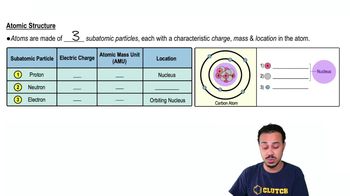
Subatomic particles are the fundamental components of atoms, which include protons, neutrons, and electrons. Protons are positively charged and reside in the nucleus, while neutrons are neutral and also found in the nucleus. Electrons are negatively charged and orbit the nucleus in electron shells. Understanding these particles is crucial for grasping atomic structure and chemical behavior.
Recommended video:
Guided course
04:48
Atomic Structure

Atomic Structure

The atomic structure refers to the arrangement of subatomic particles within an atom. In a carbon atom, there are six protons and six neutrons in the nucleus, surrounded by six electrons in two energy levels. This structure determines the atom's properties, including its reactivity and the types of bonds it can form with other atoms.
Recommended video:
Guided course
04:48
Atomic Structure

Electron Configuration

Electron configuration describes the distribution of electrons in an atom's electron shells. For carbon, the electron configuration is 1s² 2s² 2p², indicating that two electrons occupy the first shell and four occupy the second. This configuration is essential for understanding how carbon interacts with other elements, particularly in forming covalent bonds.
Recommended video:
Guided course
07:41
Electron Transport Chain