Pearson+ LogoPearson+ Logo
Ch. 16 - Conserving Biodiversity
Belk, Maier - Biology: Science for Life 6th Edition
Belk, Maier6th EditionBiology: Science for LifeISBN: 9780135214084Not the one you use?Change textbook
Chapter 16, Problem 10

One advantage of preserving more than one population of an endangered species at more than one location is
a. A lower risk of extinction of the entire species if a catastrophe strikes one location
b. Higher levels of inbreeding in each population
c. Higher rates of genetic drift in each population
d. Lower numbers of heterozygotes in each population
e. Higher rates of habitat fragmentation in the different locations

Verified step by step guidance
1
Understand the problem: The question is asking about the advantages of preserving multiple populations of an endangered species in different locations. This involves concepts like extinction risk, genetic diversity, and population dynamics.
Step 1: Recall the concept of extinction risk. If a species is preserved in only one location, a catastrophic event (e.g., natural disaster, disease outbreak) could wipe out the entire population. Having multiple populations in different locations reduces this risk.
Step 2: Consider the impact on genetic diversity. Preserving multiple populations can help maintain genetic diversity, as it reduces the likelihood of inbreeding (which occurs when closely related individuals reproduce) and allows for a broader gene pool.
Step 3: Evaluate the role of genetic drift. Genetic drift is the random change in allele frequencies in small populations. While smaller populations are more susceptible to genetic drift, having multiple populations in different locations can help buffer the species as a whole against the effects of genetic drift in any one population.
Step 4: Analyze the options provided. Option (a) aligns with the concept of reducing extinction risk by spreading populations across multiple locations. Options (b), (c), (d), and (e) either contradict the benefits of preserving multiple populations or describe negative outcomes that are not advantages.

Verified video answer for a similar problem:

This video solution was recommended by our tutors as helpful for the problem above.
Video duration:
3m
Was this helpful?

Key Concepts

Here are the essential concepts you must grasp in order to answer the question correctly.

Population Viability

Population viability refers to the ability of a species' population to survive and reproduce over time. Maintaining multiple populations across different locations reduces the risk of extinction due to localized catastrophes, such as natural disasters or disease outbreaks, ensuring that at least some populations can persist.
Recommended video:
Guided course
02:58
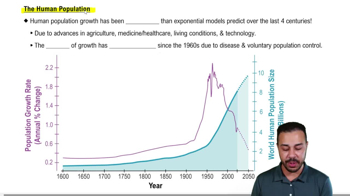
The Human Population

Genetic Diversity

Genetic diversity is the total number of genetic characteristics in the genetic makeup of a species. Higher genetic diversity within and among populations enhances resilience to environmental changes and diseases, while lower diversity can lead to inbreeding and increased vulnerability to extinction.
Recommended video:
02:37
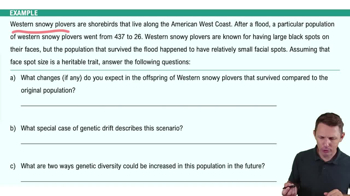
Genetic Drift Example 2

Habitat Fragmentation

Habitat fragmentation occurs when large habitats are broken into smaller, isolated patches, often due to human activities. This can lead to reduced genetic exchange between populations and increased risks of extinction, making it crucial to preserve multiple populations in diverse locations to maintain ecological integrity.
Recommended video:
Guided course
03:23
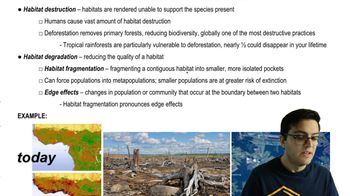
Habitat Destruction and Degradation
Related Practice
Textbook Question

The web of life refers to the

a. Evolutionary relationships among living organisms

b. Connections between species in an ecosystem

c. Complicated nature of genetic variability

d. Flow of information from parent to child

e. Predatory effect of humans on the rest of the natural world

Textbook Question

Which of the following is an example of a mutualistic relationship?

a. Moles catching and eating earthworms from the moles' underground tunnels

b. Cattails and reed canary grass growing together in wetland soils

c. Cleaner fish removing and eating parasites from the teeth of sharks

d. Colorado potato beetles consuming potato plant leaves

e. More than one of the above

Textbook Question

The risks faced by small populations include

a. Erosion of genetic variability through genetic drift

b. Decreased fitness of individuals as a result of inbreeding

c. Increased risk of experiencing natural disasters

d. A and B are correct

e. A, B, and C are correct

Textbook Question

There are fewer lions in Africa's Serengeti than there are zebras. This is principally because

a. Zebras tend to drive off lions

b. Lions compete directly with cheetahs, whereas zebras do not have any competitors

c. Zebras have mutualists that increase their population, whereas lions do not

d. There is less energy available in zebras to support the lion population than there is in grass to support the zebras

e. Zebras are a keystone species, whereas lions are not

Textbook Question

Most of the nutrients available for plant growth in an ecosystem are

a. Deposited in rain

b. Made available through the recycling of decomposers

c. Maintained within that ecosystem over time

d. B and C are correct

e. A, B, and C are correct