
Pearson+ LogoPearson+ Logo
Ch. 11 - Where Did We Come From?
Belk, Maier - Biology: Science for Life 6th Edition
Belk, Maier6th EditionBiology: Science for LifeISBN: 9780135214084Not the one you use?Change textbook
Chapter 11, Problem 10

Which of the following taxonomic levels contains organisms that share the most recent common ancestor?
a. Family
b. Order
c. Phylum
d. Genus
e. Class

Verified step by step guidance
1
Understand the hierarchy of taxonomic classification: The taxonomic levels, from broadest to most specific, are Domain, Kingdom, Phylum, Class, Order, Family, Genus, and Species. Organisms grouped at more specific levels share more recent common ancestors.
Compare the taxonomic levels provided in the question: Family, Order, Phylum, Genus, and Class. Arrange them in order of specificity: Phylum < Class < Order < Family < Genus.
Recall that the more specific the taxonomic level, the more closely related the organisms are, and the more recent their common ancestor.
Identify the most specific taxonomic level in the options: Among the given choices, 'Genus' is the most specific level.
Conclude that organisms within the same 'Genus' share the most recent common ancestor compared to the other taxonomic levels listed.

Verified video answer for a similar problem:

This video solution was recommended by our tutors as helpful for the problem above.
Video duration:
50s
Was this helpful?

Key Concepts

Here are the essential concepts you must grasp in order to answer the question correctly.

Taxonomic Hierarchy

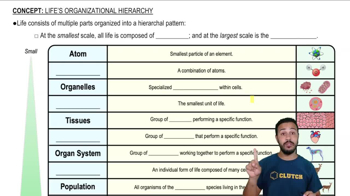
The taxonomic hierarchy is a system used to classify and organize living organisms into categories based on shared characteristics. It includes several levels, such as domain, kingdom, phylum, class, order, family, genus, and species, arranged from broadest to most specific. Understanding this hierarchy is essential for identifying relationships among organisms.
Recommended video:
Guided course
09:50
Life's Organizational Hierarchy

Common Ancestor

A common ancestor refers to a species from which two or more different species have evolved. In taxonomy, organisms that share a more recent common ancestor are grouped together at lower taxonomic levels, indicating closer evolutionary relationships. This concept is crucial for understanding evolutionary biology and the classification of organisms.
Recommended video:
06:39
Common Misconceptions

Genus and Species

The genus is a taxonomic rank that groups together species that are closely related and share a recent common ancestor. It is one of the most specific levels of classification, often followed by the species name, which identifies individual organisms. In the context of the question, the genus level contains organisms that are more closely related than those in higher taxonomic levels like family or order.
Recommended video:
03:24
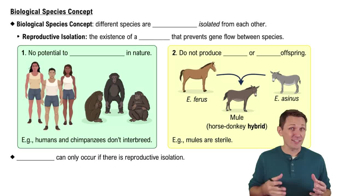
Biological Species Concept