Pearson+ LogoPearson+ Logo
Ch. 11 - Where Did We Come From?
Belk, Maier - Biology: Science for Life 6th Edition
Belk, Maier6th EditionBiology: Science for LifeISBN: 9780135214084Not the one you use?Change textbook
Chapter 11, Problem 4

Add labels to the figure that follows, which illustrates how Mycobacterium tuberculosis evolves when it is exposed to an antibiotic.
Illustration of Mycobacterium tuberculosis evolution under antibiotic treatment.
Diagram showing M. tuberculosis variants before and after antibiotic treatment.

Verified step by step guidance
1
Step 1: Observe the first image (A) in the figure. It represents the initial population of Mycobacterium tuberculosis, which includes a mix of antibiotic-susceptible and antibiotic-resistant variants. The red, yellow, blue, and green circles symbolize different bacterial variants.
Step 2: Note the process labeled 'Treatment with an antibiotic.' This step involves applying an antibiotic to the bacterial population. Antibiotic-susceptible variants (e.g., red and green) are killed, as indicated by the 'X' marks over them in the second image.
Step 3: In the second image, observe that some variants (e.g., yellow and blue) survive the antibiotic treatment. These surviving variants are likely antibiotic-resistant strains.
Step 4: In the final image (B), the surviving antibiotic-resistant variants (yellow and blue) proliferate, leading to a population dominated by resistant bacteria. This demonstrates the process of natural selection, where resistant variants survive and reproduce.
Step 5: Label the figure accordingly: (A) 'Initial population with both antibiotic-susceptible and antibiotic-resistant variants,' (middle) 'Antibiotic treatment eliminates susceptible variants,' and (B) 'Population dominated by antibiotic-resistant variants after treatment.'

Verified video answer for a similar problem:

This video solution was recommended by our tutors as helpful for the problem above.
Video duration:
2m
Was this helpful?

Key Concepts

Here are the essential concepts you must grasp in order to answer the question correctly.

Antibiotic Resistance

Antibiotic resistance occurs when bacteria evolve mechanisms to withstand the effects of drugs that once killed them or inhibited their growth. This can happen through genetic mutations or acquiring resistance genes from other bacteria. In the context of Mycobacterium tuberculosis, exposure to antibiotics can lead to the survival of resistant strains, complicating treatment efforts.
Recommended video:
04:25
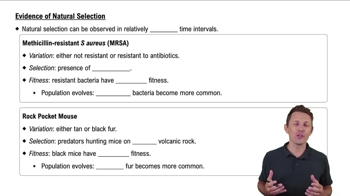
Evidence of Natural Selection

Natural Selection

Natural selection is a fundamental mechanism of evolution where organisms better adapted to their environment tend to survive and reproduce more than those less adapted. In the case of antibiotic treatment, bacteria that possess mutations allowing them to survive the antibiotic will proliferate, leading to a population dominated by resistant variants, as illustrated in the figure.
Recommended video:
04:43
Natural Selection

Mutation and Variation

Mutation refers to changes in the DNA sequence of an organism, which can lead to variations in traits. In bacteria like Mycobacterium tuberculosis, mutations can confer advantages such as antibiotic resistance. The presence of genetic variation within a bacterial population is crucial for natural selection to occur, as it provides the raw material for evolution in response to environmental pressures like antibiotic treatment.
Recommended video:
Related Practice
Textbook Question

The process of biological evolution

a. Is not supported by scientific evidence

b. Results in a change in the features of individuals in a population

c. Takes place over the course of generations

d. B and C are correct

e. A, B, and C are correct

Textbook Question
Describe three ways that evolution can occur via genetic drift.
Textbook Question

In science, a theory is a(n)

a. Educated guess

b. Inference based on a lack of scientific evidence

c. Idea with little experimental support

d. Body of scientifically acceptable general principles

e. Statement of fact

7
views
Textbook Question

The theory of common descent states that all modern organisms

a. Can change in response to environmental change

b. Descended from a single common ancestor

c. Descended from one of many ancestors that originally arose on Earth

d. Have not evolved

e. Can be arranged in a hierarchy from 'least evolved' to 'most evolved'

Textbook Question

The DNA sequence for the same gene found in several species of mammals_________.

a. Is identical among all species.

b. Is equally different between all pairs of mammal species.

c. Is more similar between closely related species than between distantly related species.

d. Provides evidence for the hypothesis of common descent

e. More than one of the above is correct.

Textbook Question

Marsupial mammals give birth to young that complete their development in a pouch on the mother's abdomen. All the native mammals of Australia are marsupials, while these types of mammals are absent or uncommon on other continents. This observation is an example of

a. Developmental evidence for evolution

b. Biogeographic evidence for evolution

c. Genetic evidence for evolution

d. Fossil evidence for evolution

e. Not useful evidence for evolution