Skip to main content
Organic Chemistry
My Course
Learn
Exam Prep
AI Tutor
Study Guides
Textbook Solutions
Flashcards
Explore
My Course
Learn
Exam Prep
AI Tutor
Study Guides
Textbook Solutions
Flashcards
Explore
Back
Oxidizing Agent quiz
You can tap to flip the card.
What is the oxidizing agent in the reaction: pyruvate + NADH + H+ → lactate + NAD+?
You can tap to
flip the card.
👆
What is the oxidizing agent in the reaction: pyruvate + NADH + H+ → lactate + NAD+?
The oxidizing agent in this reaction is pyruvate, as it accepts electrons from NADH, which is oxidized to NAD+.
Track progress
Control buttons has been changed to "navigation" mode.
1/10
Related practice
Recommended videos
Guided course
01:52
Reagents
Johnny
Guided course
03:40
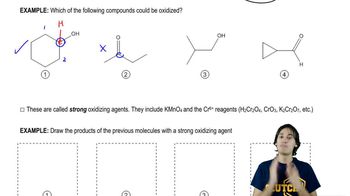
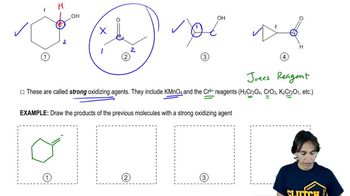
Strong oxidizing agents
Johnny
Guided course
00:52
Strong oxidizing agents
Johnny
Terms in this set (10)
Hide definitions
What is the oxidizing agent in the reaction: pyruvate + NADH + H+ → lactate + NAD+?
The oxidizing agent in this reaction is pyruvate, as it accepts electrons from NADH, which is oxidized to NAD+.
What is the role of an oxidizing agent in a chemical reaction?
An oxidizing agent accepts electrons from another species, causing the oxidation of that species while itself being reduced.
What is Jones' reagent commonly used for in organic chemistry?
Jones' reagent is commonly used to oxidize secondary alcohols to ketones.
What is a key rule to remember about oxidizing agents in organic reactions?
Oxidizing agents add oxygen to molecules without breaking carbon-carbon bonds, except in specific cases like ozonolysis.
What is the first step in the oxidation mechanism using Jones' reagent?
The first step is a nucleophilic attack by the alcohol on the chromium in the chromic acid.
What is the significance of alpha elimination in oxidation mechanisms?
Alpha elimination forms a double bond directly on the alpha carbon to a non-carbon atom, such as oxygen.
What happens to the chromic acid after it acts as an oxidizing agent?
The chromic acid is reduced and eventually reforms, but it is not the focus of the oxidation process.
What is the final product when a secondary alcohol is oxidized using a strong oxidizing agent?
The final product is a ketone, as the alcohol is converted by forming a double bond with oxygen.
Why is it important to distinguish between strong and weak oxidizing agents?
Understanding the strength of oxidizing agents helps predict the extent of oxidation and the possible products formed.
What is the role of water in the oxidation mechanism using Jones' reagent?
Water acts as a base to deprotonate the intermediate, facilitating the formation of the ketone product.
 Back
Back
 Back
Back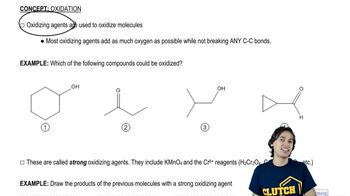
 01:52
01:52