Skip to main content
Organic Chemistry
My Course
Learn
Exam Prep
AI Tutor
Study Guides
Textbook Solutions
Flashcards
Explore
My Course
Learn
Exam Prep
AI Tutor
Study Guides
Textbook Solutions
Flashcards
Explore
Back
Electronegativity quiz
You can tap to flip the card.
Are electrons always shared equally between atoms in a chemical bond?
You can tap to
flip the card.
👆
Are electrons always shared equally between atoms in a chemical bond?
No, electrons are not always shared equally; unequal sharing leads to polar covalent bonds and dipole moments.
Track progress
Control buttons has been changed to "navigation" mode.
1/10
Related practice
Recommended videos
Guided course
11:33
Differences between ionic, polar and covalent bonds
Johnny
Terms in this set (10)
Hide definitions
Are electrons always shared equally between atoms in a chemical bond?
No, electrons are not always shared equally; unequal sharing leads to polar covalent bonds and dipole moments.
What is a dipole moment?
A dipole moment is the measure of the separation of positive and negative charges in a bond, resulting from unequal sharing of electrons.
How is the dipole moment calculated?
The dipole moment is calculated based on the charge difference between two atoms and the distance between them.
What is the Pauling Electronegativity Scale used for?
The Pauling Electronegativity Scale is used to determine the charge difference between atoms, which helps identify the type of bond.
What electronegativity difference indicates a covalent bond?
An electronegativity difference of less than 0.5 indicates a covalent bond.
What type of bond is formed when the electronegativity difference is between 0.5 and 2.0?
A polar covalent bond is formed when the electronegativity difference is between 0.5 and 2.0.
What happens to electrons in an ionic bond?
In an ionic bond, electrons are not shared but are transferred, resulting in one atom being more electronegative and carrying a negative charge.
Why are bonds between carbon and hydrogen always covalent?
Bonds between carbon and hydrogen are always covalent because their electronegativity difference is only 0.4, which is too small to be polar.
What results from polar bonds in terms of charges?
Polar bonds result in partial charges, with the more electronegative atom having a partial negative charge.
What is a net dipole?
A net dipole exists when there are asymmetrical dipole moments in a molecule, resulting in an overall dipole moment.
 Back
Back
 Back
Back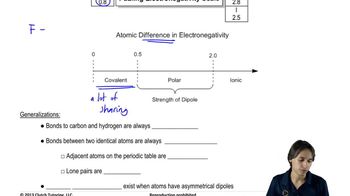
 11:33
11:33