Pearson+ LogoPearson+ Logo
Ch.8 Solution Chemistry Sugar and Water Do Mix
Frost - General, Organic and Biological Chemistry 4th Edition
Frost4th EditionGeneral, Organic and Biological ChemistryISBN: 9780134988696Not the one you use?Change textbook
Chapter 5, Problem 54b

Identify the type of transport (passive diffusion, facilitated transport, or active transport) that will occur for the following molecules:
(b) nitrogen

Verified step by step guidance
1
Understand the three types of transport mechanisms: Passive diffusion involves movement of molecules from high to low concentration without energy or assistance. Facilitated transport requires a protein channel or carrier but no energy. Active transport requires energy (ATP) to move molecules against their concentration gradient.
Consider the properties of nitrogen (N₂): It is a small, nonpolar molecule and does not carry a charge.
Recall that small, nonpolar molecules can easily pass through the lipid bilayer of a cell membrane without the need for proteins or energy.
Determine that nitrogen (N₂) will move across the membrane via passive diffusion because it meets the criteria for this type of transport.
Conclude that passive diffusion is the transport mechanism for nitrogen (N₂) based on its molecular characteristics and the nature of the cell membrane.

Verified video answer for a similar problem:

This video solution was recommended by our tutors as helpful for the problem above.
Video duration:
7m
Was this helpful?

Key Concepts

Here are the essential concepts you must grasp in order to answer the question correctly.

Passive Diffusion

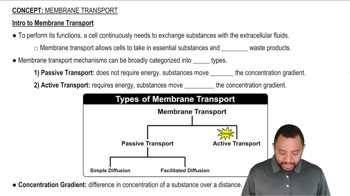
Passive diffusion is the movement of molecules across a cell membrane without the need for energy input. This process occurs when molecules move from an area of higher concentration to an area of lower concentration, following their concentration gradient. Small, nonpolar molecules, like nitrogen, typically utilize passive diffusion to enter or exit cells.
Recommended video:
Guided course
1:21
Membrane Transport Concept 1

Facilitated Transport

Facilitated transport is a type of passive transport that requires specific transport proteins to help move molecules across the cell membrane. This process is essential for larger or polar molecules that cannot easily pass through the lipid bilayer. Unlike active transport, facilitated transport does not require energy, as it also moves substances down their concentration gradient.
Recommended video:
Guided course
1:21
Membrane Transport Concept 1

Active Transport

Active transport is the process by which cells move molecules against their concentration gradient, from areas of lower concentration to areas of higher concentration. This process requires energy, usually in the form of ATP, and is mediated by specific transport proteins. Active transport is crucial for maintaining cellular concentrations of ions and nutrients that differ from their surroundings.
Recommended video:
Guided course
1:21
Membrane Transport Concept 1