Ch.12 Food as Fuel An Overview of Metabolism
Frost - General, Organic and Biological Chemistry 4th Edition
Frost4th EditionGeneral, Organic and Biological ChemistryISBN: 9780134988696Not the one you use?Change textbook
Chapter 8, Problem 67d

Identify the type of food—carbohydrate, fat, or protein—that gives each of the following digestion products:
d. glycerol

Verified step by step guidance
1
Understand the digestion process: Different types of food (carbohydrates, fats, and proteins) are broken down into specific smaller molecules during digestion. These smaller molecules are characteristic of the type of food being digested.
Recall the digestion products of fats: Fats, also known as lipids, are broken down into glycerol and fatty acids during digestion. This process is facilitated by enzymes such as lipase.
Compare glycerol to the digestion products of carbohydrates and proteins: Carbohydrates are broken down into monosaccharides (e.g., glucose), while proteins are broken down into amino acids. Glycerol is not a product of carbohydrate or protein digestion.
Identify glycerol as a digestion product of fats: Since glycerol is specifically produced when fats are digested, it is associated with fats.
Conclude that glycerol is a digestion product of fats and not carbohydrates or proteins.

Verified video answer for a similar problem:

This video solution was recommended by our tutors as helpful for the problem above.
Video duration:
1m
Was this helpful?

Key Concepts

Here are the essential concepts you must grasp in order to answer the question correctly.

Glycerol

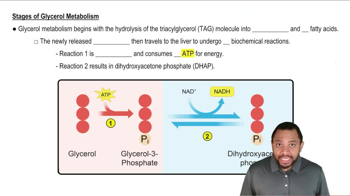
Glycerol is a simple polyol compound that serves as a backbone for triglycerides, which are the main form of fat storage in the body. It is produced during the digestion of fats, specifically when triglycerides are broken down by enzymes. Understanding glycerol's role is essential for recognizing how fats are metabolized and utilized for energy.
Recommended video:
Guided course
1:20
Glycerol Metabolism Concept 2

Digestion of Fats

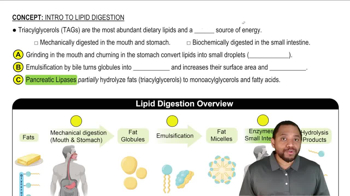
The digestion of fats involves the breakdown of triglycerides into glycerol and fatty acids through the action of lipases. This process occurs primarily in the small intestine, where bile salts emulsify fats, making them more accessible to digestive enzymes. Recognizing this process is crucial for linking glycerol to its source, which is dietary fat.
Recommended video:
Guided course
2:54
Intro to Lipid Digestion Concept 1

Macronutrients

Macronutrients are the nutrients required in large amounts for energy and bodily functions, including carbohydrates, fats, and proteins. Each macronutrient has distinct roles in metabolism and provides different digestion products. Understanding the classification of macronutrients helps in identifying which type of food corresponds to specific digestion products like glycerol.