Pearson+ LogoPearson+ Logo
Ch.11 Nucleic Acids Big Molecules with a Big Role
Frost - General, Organic and Biological Chemistry 4th Edition
Frost4th EditionGeneral, Organic and Biological ChemistryISBN: 9780134988696Not the one you use?Change textbook
Chapter 7, Problem 71b

Provide the three-letter amino acid sequence expected from each of the following mRNA segments:
b. 5'CUA|AGC|UUC|AAC|UGG3'

Verified step by step guidance
1
Identify the codons in the mRNA sequence by dividing the sequence into groups of three nucleotides. For the given sequence, the codons are: CUA, AGC, UUC, AAC, and UGG.
Use the genetic code table to determine the amino acid corresponding to each codon. For example, CUA codes for Leucine (Leu), AGC codes for Serine (Ser), UUC codes for Phenylalanine (Phe), AAC codes for Asparagine (Asn), and UGG codes for Tryptophan (Trp).
Convert the full names of the amino acids into their three-letter abbreviations. For instance, Leucine becomes Leu, Serine becomes Ser, Phenylalanine becomes Phe, Asparagine becomes Asn, and Tryptophan becomes Trp.
Write the amino acid sequence in the order corresponding to the codons in the mRNA segment. Ensure the sequence is presented as three-letter abbreviations separated by hyphens.
Double-check the sequence to confirm that each codon has been correctly translated into its corresponding amino acid and that the sequence matches the original mRNA codon order.

Verified video answer for a similar problem:

This video solution was recommended by our tutors as helpful for the problem above.
Video duration:
4m
Was this helpful?

Key Concepts

Here are the essential concepts you must grasp in order to answer the question correctly.

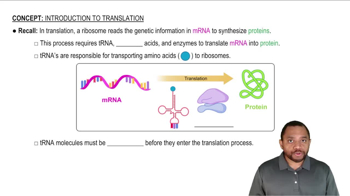
mRNA Translation

mRNA translation is the process by which ribosomes synthesize proteins by decoding the messenger RNA (mRNA) sequence. Each set of three nucleotides, known as a codon, corresponds to a specific amino acid. Understanding this process is crucial for determining the amino acid sequence from an mRNA strand.
Recommended video:
Guided course
1:42
Introduction to Translation Concept 1

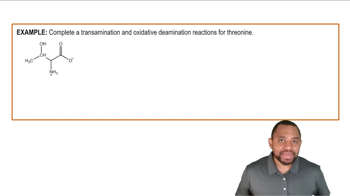
Codons and Amino Acids

Codons are sequences of three nucleotides in mRNA that specify a particular amino acid during protein synthesis. The genetic code is universal, meaning that the same codons correspond to the same amino acids across different organisms. Familiarity with the codon table is essential for translating mRNA sequences into their respective amino acids.
Recommended video:
Guided course
3:03
Amino Acid Catabolism: Amino Group Example 2

Reading Frame

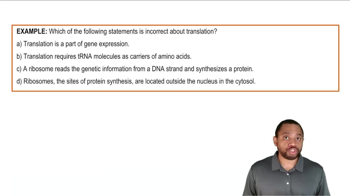
The reading frame refers to the way nucleotides in mRNA are grouped into codons for translation. It is determined by the starting point of translation and can affect the resulting amino acid sequence. A shift in the reading frame can lead to completely different proteins, making it important to maintain the correct frame when translating mRNA.
Recommended video:
Guided course
1:30
Introduction to Translation Example 1