Pearson+ LogoPearson+ Logo
Ch. 3 - Mendelian Genetics
Klug - Essentials of Genetics 10th Edition
Klug10th EditionEssentials of GeneticsISBN: 9780135588789Not the one you use?Change textbook
Chapter 3, Problem 12c

In Drosophila, gray body color is dominant to ebony body color, while long wings are dominant to vestigial wings. Assuming that the P₁ individuals are homozygous, work the following crosses through the F₂ generation, and determine the genotypic and phenotypic ratios for each generation.
gray, long x gray, vestigial.

Verified step by step guidance
1
Identify the traits and their dominance relationships: gray body color (G) is dominant to ebony body color (g), and long wings (L) are dominant to vestigial wings (l).
Determine the genotypes of the P₁ generation: since P₁ individuals are homozygous, the gray, long individual is G G L L, and the gray, vestigial individual is G G l l.
Perform the P₁ cross by combining the genotypes: cross G G L L (gray, long) with G G l l (gray, vestigial). Since both parents are homozygous, all F₁ offspring will have the genotype G G L l.
Set up the F₁ cross by mating two F₁ individuals (G G L l x G G L l) to produce the F₂ generation. Use a Punnett square to determine all possible genotypes for the wing trait (L l x L l) while body color remains G G (gray) in all offspring.
From the Punnett square, determine the genotypic ratios for the wing trait (L L, L l, l l) and combine with the body color genotype (G G) to find the phenotypic ratios in the F₂ generation: gray body with long wings, and gray body with vestigial wings.

Verified video answer for a similar problem:

This video solution was recommended by our tutors as helpful for the problem above.
Video duration:
3m
Was this helpful?

Key Concepts

Here are the essential concepts you must grasp in order to answer the question correctly.

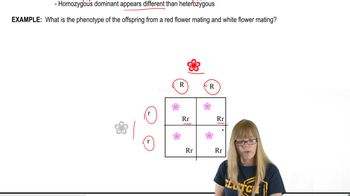
Mendelian Inheritance and Dominance

Mendelian inheritance describes how traits are passed from parents to offspring through dominant and recessive alleles. A dominant allele masks the expression of a recessive allele in heterozygotes, resulting in the dominant phenotype. Understanding dominance is essential to predict phenotypic outcomes in crosses.
Recommended video:
Guided course
04:37
Variations on Dominance

Genotypic and Phenotypic Ratios

Genotypic ratios represent the proportion of different genetic combinations (e.g., homozygous dominant, heterozygous, homozygous recessive) in offspring, while phenotypic ratios show the distribution of observable traits. Calculating these ratios helps interpret the results of genetic crosses across generations.
Recommended video:
Guided course
07:52
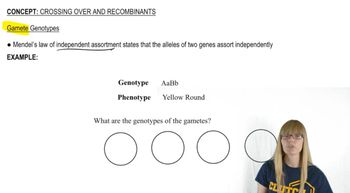
Gamete Genotypes

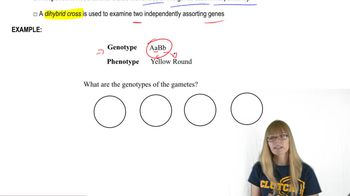
Dihybrid Crosses and Independent Assortment

A dihybrid cross involves two traits, each with two alleles, and follows Mendel’s law of independent assortment, which states that alleles of different genes segregate independently. This concept is crucial for predicting the combinations of traits in the F₂ generation when crossing individuals differing in two characteristics.
Recommended video:
Guided course
04:58
Gamete Genetics and Independent Assortment