Pearson+ LogoPearson+ Logo
Ch. 20 - Quantitative Genetics and Multifactorial Traits
Klug - Essentials of Genetics 10th Edition
Klug10th EditionEssentials of GeneticsISBN: 9780135588789Not the one you use?Change textbook
Chapter 20, Problem 19

In a population of tomato plants, mean fruit weight is 60 g and is 0.3. Predict the mean weight of the progeny if tomato plants whose fruit averaged 80 g were selected from the original population and interbred.

Verified step by step guidance
1
Identify the given information: the population mean fruit weight (\( \bar{P} = 60 \) g), the heritability in the narrow sense (\( h^2 = 0.3 \)), and the mean fruit weight of the selected parents (\( \bar{S} = 80 \) g).
Calculate the selection differential (\( S \)), which is the difference between the mean of the selected parents and the population mean: \[ S = \bar{S} - \bar{P} \]
Use the breeder's equation to predict the response to selection (\( R \)), which is the expected change in the progeny mean compared to the original population mean: \[ R = h^2 \times S \]
Calculate the predicted mean fruit weight of the progeny (\( \bar{P'} \)) by adding the response to selection to the original population mean: \[ \bar{P'} = \bar{P} + R \]
Interpret the result as the expected average fruit weight of the progeny from the selected parents, considering the heritability and selection differential.

Verified video answer for a similar problem:

This video solution was recommended by our tutors as helpful for the problem above.
Video duration:
2m
Was this helpful?

Key Concepts

Here are the essential concepts you must grasp in order to answer the question correctly.

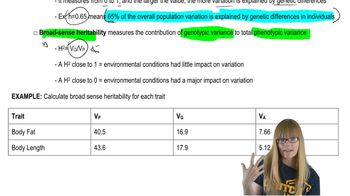
Heritability (h²)

Heritability in the narrow sense (h²) measures the proportion of phenotypic variance in a population that is due to additive genetic factors. It ranges from 0 to 1 and indicates how much of the trait variation can be passed from parents to offspring. A higher h² means stronger genetic influence on the trait.
Recommended video:
Guided course
07:04
Calculating Heritability

Selection Differential (S)

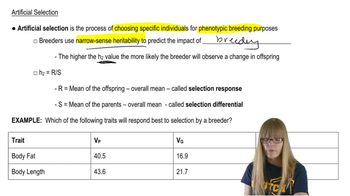
The selection differential is the difference between the mean phenotype of the selected parents and the mean phenotype of the original population. It quantifies the strength of selection applied and is used to predict the response to selection in the next generation.
Recommended video:
Guided course
04:15
Artificial Selection

Response to Selection (R)

Response to selection is the change in the mean phenotype of the progeny compared to the original population mean. It is calculated as R = h² × S, showing how much the trait mean shifts due to selection based on heritability and selection differential.
Recommended video:
Guided course
04:15
Artificial Selection
Related Practice