
Textbook Question
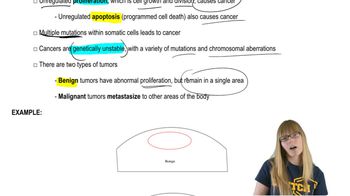
Of the two classes of genes associated with cancer, tumor-suppressor genes and oncogenes, mutations in which group can be considered gain-of-function mutations? In which group are the loss-of-function mutations? Explain.


 Verified step by step guidance
 04:29
04:29
 09:46
09:46 03:38
03:38Of the two classes of genes associated with cancer, tumor-suppressor genes and oncogenes, mutations in which group can be considered gain-of-function mutations? In which group are the loss-of-function mutations? Explain.
How do translocations such as the Philadelphia chromosome contribute to cancer?
How do normal cells protect themselves from accumulating mutations in genes that could lead to cancer? How do cancer cells differ from normal cells in these processes?
Genetic tests that detect mutations in the BRCA1 and BRCA2 tumor-suppressor genes are widely available. These tests reveal a number of mutations in these genes—mutations that have been linked to familial breast cancer. Assume that a young woman in a suspected breast cancer family takes the BRCA1 and BRCA2 genetic tests and receives negative results. That is, she does not test positive for the mutant alleles of BRCA1 or BRCA2. Can she consider herself free of risk for breast cancer?
As part of a cancer research project, you have discovered a gene that is mutated in many metastatic tumors. After determining the DNA sequence of this gene, you compare the sequence with those of other genes in the human genome sequence database. Your gene appears to code for an amino acid sequence that resembles sequences found in some serine proteases. Conjecture how your new gene might contribute to the development of highly invasive cancers.