Consider the reaction: 8 H2S(g) + 4 O2(g) → 8 H2O(g) + S8(g) Complete the table.
Ch.15 - Chemical Kinetics

Chapter 15, Problem 29a
For the reaction 2 A(g) + B(g) → 3 C(g), a. Determine the expression for the rate of the reaction in terms of the change in concentration of each of the reactants and products.
Verified step by step guidance1
Start by understanding that the rate of a reaction is defined as the change in concentration of a reactant or product per unit time.
For the given reaction 2 A(g) + B(g) → 3 C(g), identify the stoichiometric coefficients: 2 for A, 1 for B, and 3 for C.
The rate of disappearance of a reactant is negative, while the rate of appearance of a product is positive.
Write the rate expression for each species: Rate = -\(\frac{1}{2}\)\(\frac{d[A]}{dt}\) = -\(\frac{d[B]}{dt}\) = \(\frac{1}{3}\)\(\frac{d[C]}{dt}\).
These expressions ensure that the rate of the reaction is the same regardless of which species' concentration change is being measured.

Verified video answer for a similar problem:
This video solution was recommended by our tutors as helpful for the problem above.
Video duration:
2mWas this helpful?
Key Concepts
Here are the essential concepts you must grasp in order to answer the question correctly.
Rate of Reaction
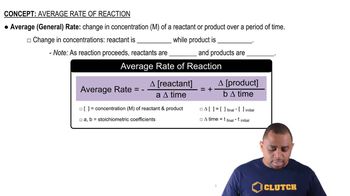
The rate of a chemical reaction is a measure of how quickly reactants are converted into products. It is typically expressed as the change in concentration of a reactant or product per unit time. For a reaction, the rate can be influenced by factors such as temperature, concentration, and the presence of catalysts.
Recommended video:
Guided course
Average Rate of Reaction
Stoichiometry
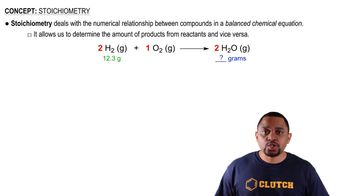
Stoichiometry involves the quantitative relationships between the amounts of reactants and products in a chemical reaction, as dictated by the balanced chemical equation. In the given reaction, the coefficients indicate the molar ratios of A, B, and C, which are essential for determining how changes in concentration affect the rate of the reaction.
Recommended video:
Guided course
Stoichiometry Concept
Change in Concentration
The change in concentration refers to the difference in the concentration of a substance over a specific time interval. In the context of the reaction, it is crucial to express the rate in terms of the changes in concentration of both reactants and products, allowing for a comprehensive understanding of how the reaction progresses over time.
Recommended video:
Guided course
Chemical Changes
Related Practice
Textbook Question
1
views
Textbook Question
Consider the reaction:
2 HBr (g) → H2 (g) + Br2 (g)
b. In the first 20.0 s of this reaction, the concentration of HBr dropped from 0.600 M to 0.512 M. Calculate the average rate of the reaction during this time interval.
Textbook Question
Consider the reaction:
2 HBr (g) → H2 (g) + Br2 (g)
c. If the volume of the reaction vessel in part b was 1.25 L, what amount of Br2 (in moles) was formed during the first 15.0 s of the reaction?
Textbook Question
Consider the reaction: 2 N2O( g) → 2 N2(g) + O2(g) a. Express the rate of the reaction in terms of the change in concentration of each of the reactants and products.
1
views
Textbook Question
For the reaction 2 A(gg) + B(g) → 3 C(g), b. when A is decreasing at a rate of 0.200 M/s, how fast is B decreasing? How fast is C increasing?