

Ch.21 - Radioactivity & Nuclear Chemistry
Tro5th EditionChemistry: A Molecular ApproachISBN: 9780134874371
Not the one you use?Change textbookSelect a different textbook
Table of contents
- Ch.1 - Matter, Measurement & Problem Solving117
- Ch.2 - Atoms & Elements106
- Ch.3 - Molecules and Compounds128
- Ch.4 - Chemical Reactions and Chemical Quantities56
- Ch.5 - Introduction to Solutions and Aqueous Solutions84
- Ch.6 - Gases112
- Ch.7 - Thermochemistry96
- Ch.8 - The Quantum-Mechanical Model of the Atom60
- Ch.9 - Periodic Properties of the Elements86
- Ch.10 - Chemical Bonding I: The Lewis Model91
- Ch.11 - Chemical Bonding II: Molecular Shapes, VSEPR & MO Theory85
- Ch.12 - Liquids, Solids & Intermolecular Forces51
- Ch.13 - Solids & Modern Materials48
- Ch.14 - Solutions93
- Ch.15 - Chemical Kinetics114
- Ch.16 - Chemical Equilibrium68
- Ch.17 - Acids and Bases137
- Ch.18 - Aqueous Ionic Equilibrium154
- Ch.19 - Free Energy & Thermodynamics91
- Ch.20 - Electrochemistry105
- Ch.21 - Radioactivity & Nuclear Chemistry74
- Ch.22 - Organic Chemistry141

Chapter 21, Problem 54
A mammoth skeleton has a carbon-14 decay rate of 0.48 disintegration per minute per gram of carbon (0.48 dis/min • g C). When did the mammoth live? (Assume that living organisms have a carbon-14 decay rate of 15.3 dis/min • g C and that carbon- 14 has a half-life of 5715 yr.)
 Verified step by step guidance
1
Identify the given values: the current decay rate of the mammoth skeleton is 0.48 dis/min \( \cdot \) g C, the decay rate of living organisms is 15.3 dis/min \( \cdot \) g C, and the half-life of carbon-14 is 5715 years.
Use the formula for radioactive decay: \( N = N_0 \times e^{-\lambda t} \), where \( N \) is the current decay rate, \( N_0 \) is the initial decay rate, \( \lambda \) is the decay constant, and \( t \) is the time elapsed.
Calculate the decay constant \( \lambda \) using the half-life formula: \( \lambda = \frac{\ln(2)}{\text{half-life}} \).
Rearrange the decay formula to solve for \( t \): \( t = \frac{\ln(N_0/N)}{\lambda} \).
Substitute the known values into the rearranged formula to calculate the time \( t \) when the mammoth lived.
Verified video answer for a similar problem:
This video solution was recommended by our tutors as helpful for the problem above.

Video duration:
5mWas this helpful?
Key Concepts
Here are the essential concepts you must grasp in order to answer the question correctly.
Carbon-14 Dating
Carbon-14 dating is a radiometric dating method used to determine the age of organic materials by measuring the amount of carbon-14 they contain. Living organisms absorb carbon-14 from the atmosphere, and when they die, the carbon-14 begins to decay at a known rate, characterized by its half-life. This technique is particularly useful for dating materials up to about 50,000 years old.
Recommended video:
Guided course
 03:48
03:48
3 and 4 Carbon Alkyls
Half-Life
The half-life of a radioactive isotope is the time required for half of the isotope in a sample to decay into a different element or isotope. For carbon-14, the half-life is approximately 5,715 years. Understanding half-life is crucial for calculating the age of a sample based on the remaining amount of carbon-14 compared to its initial concentration in living organisms.
Recommended video:
Guided course
 02:17
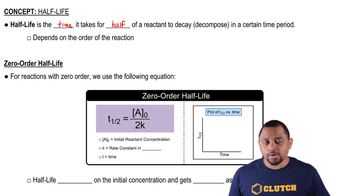
02:17Zero-Order Half-life
Disintegration Rate
The disintegration rate refers to the number of radioactive decays occurring per unit time, typically expressed in disintegrations per minute (dis/min). In this context, the disintegration rate of carbon-14 in living organisms is higher than in a deceased organism, allowing scientists to estimate the time since death by comparing the current decay rate to the known rate in living organisms.
Recommended video:
Guided course
 01:30
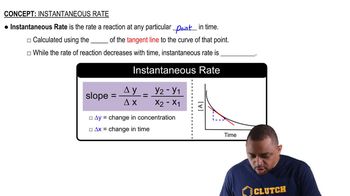
01:30Instantaneous Rate
Related Practice