Silicon has three naturally occurring isotopes (Si-28, Si-29, and Si-30). The mass and natural abundance of Si-28 are 27.9769 amu and 92.2%, respectively. The mass and natural abundance of Si-29 are 28.9765 amu and 4.67%, respectively. Find the mass and natural abundance of Si-30.
Ch.2 - Atoms & Elements
Chapter 2, Problem 75
An element has two naturally occurring isotopes. Isotope 1 has a mass of 120.9038 amu and a relative abundance of 57.4%, and isotope 2 has a mass of 122.9042 amu. Find the atomic mass of this element and identify it.
Verified step by step guidance1
First, we need to understand that the atomic mass of an element is the weighted average of the masses of its isotopes. The weight of each isotope is determined by its relative abundance. In this case, we have two isotopes with known masses and one known relative abundance.
Next, we need to find the relative abundance of the second isotope. Since the total relative abundance of all isotopes of an element must add up to 100%, we subtract the relative abundance of the first isotope from 100%. So, the relative abundance of isotope 2 is 100% - 57.4%.
Then, we convert the relative abundances from percentages to fractions by dividing by 100. So, the relative abundance of isotope 1 is 57.4/100 and the relative abundance of isotope 2 is (100-57.4)/100.
Now, we can calculate the atomic mass of the element. We multiply the mass of each isotope by its relative abundance (in fraction form) and then add these values together. So, the atomic mass is (120.9038 amu * relative abundance of isotope 1) + (122.9042 amu * relative abundance of isotope 2).
Finally, to identify the element, we can compare the calculated atomic mass to the atomic masses of known elements. The element with the atomic mass closest to our calculated value is the element we are looking for.

Verified video answer for a similar problem:
This video solution was recommended by our tutors as helpful for the problem above.
Was this helpful?
Key Concepts
Here are the essential concepts you must grasp in order to answer the question correctly.
Isotopes
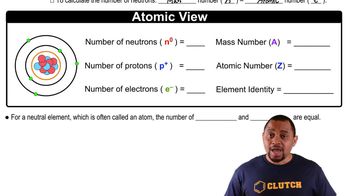
Isotopes are variants of a chemical element that have the same number of protons but different numbers of neutrons, resulting in different atomic masses. For example, in the question, the element has two isotopes with distinct masses, which contribute to the overall atomic mass of the element based on their relative abundances.
Recommended video:
Guided course
Isotopes
Relative Abundance
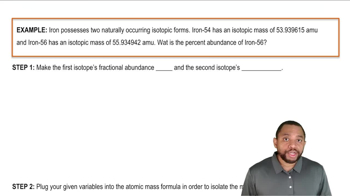
Relative abundance refers to the proportion of each isotope of an element present in a natural sample. It is expressed as a percentage and is crucial for calculating the weighted average atomic mass of an element, as seen in the question where Isotope 1 has a relative abundance of 57.4%.
Recommended video:
Guided course
Calculating Abundance Example
Atomic Mass Calculation
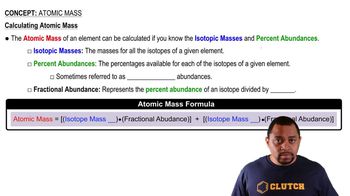
The atomic mass of an element is calculated by taking the weighted average of the masses of its isotopes, factoring in their relative abundances. The formula involves multiplying the mass of each isotope by its relative abundance (in decimal form) and summing these values to find the overall atomic mass.
Recommended video:
Guided course
Calculating Atomic Mass
Related Practice
Textbook Question
3
views
Textbook Question
The atomic mass of fluorine is 18.998 amu, and its mass spectrum shows a large peak at this mass. The atomic mass of chlorine is 35.45 amu, yet the mass spectrum of chlorine does not show a peak at this mass. Explain the difference.
Textbook Question
An element has four naturally occurring isotopes with the masses and natural abundances given here. Find the atomic mass of the element and identify it.
Isotope Mass (amu) Abundance (%)
1 135.90714 0.19
2 137.90599 0.25
3 139.90543 88.43
4 141.90924 11.13
Textbook Question
Bromine has two naturally occurring isotopes (Br-79 and Br-81) and has an atomic mass of 79.904 amu. The mass of Br-81 is 80.9163 amu, and its natural abundance is 49.31%. Calculate the mass and natural abundance of Br-79.
4
views
