A cylinder with a moveable piston contains 0.553 mol of gas and has a volume of 253 mL. What is its volume if an additional 0.365 mol of gas is added to the cylinder? (Assume constant temperature and pressure.)

Ch.5 - Gases
Chapter 5, Problem 37a
What volume is occupied by 0.118 mol of helium gas at a pressure of 0.97 atm and a temperature of 305 K?
Verified step by step guidance1
Identify the ideal gas law equation: \( PV = nRT \), where \( P \) is pressure, \( V \) is volume, \( n \) is the number of moles, \( R \) is the ideal gas constant, and \( T \) is temperature.
Rearrange the ideal gas law equation to solve for volume \( V \): \( V = \frac{nRT}{P} \).
Substitute the given values into the equation: \( n = 0.118 \text{ mol} \), \( P = 0.97 \text{ atm} \), \( T = 305 \text{ K} \), and \( R = 0.0821 \text{ L atm/mol K} \).
Calculate the volume \( V \) by plugging the values into the rearranged equation: \( V = \frac{0.118 \times 0.0821 \times 305}{0.97} \).
Simplify the expression to find the volume \( V \) in liters.

Verified video answer for a similar problem:
This video solution was recommended by our tutors as helpful for the problem above.
Video duration:
7mWas this helpful?
Key Concepts
Here are the essential concepts you must grasp in order to answer the question correctly.
Ideal Gas Law
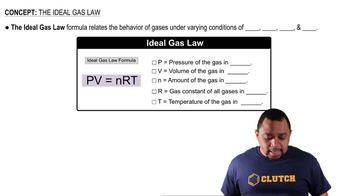
The Ideal Gas Law is a fundamental equation in chemistry that relates the pressure, volume, temperature, and number of moles of a gas. It is expressed as PV = nRT, where P is pressure, V is volume, n is the number of moles, R is the ideal gas constant, and T is temperature in Kelvin. This law allows us to calculate the volume occupied by a gas under specific conditions.
Recommended video:
Guided course
Ideal Gas Law Formula
Units of Measurement
Understanding the units of measurement is crucial in gas calculations. Pressure is often measured in atmospheres (atm), volume in liters (L), and temperature in Kelvin (K). In the Ideal Gas Law, consistency in units is essential; for example, the ideal gas constant R can be expressed in different units depending on the pressure and volume units used, which affects the final calculations.
Recommended video:
Guided course
Units of Radiation Measurement
Gas Behavior at Different Conditions
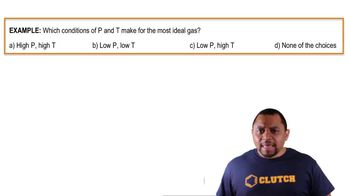
Gases behave differently under varying conditions of pressure and temperature. According to the kinetic molecular theory, gas particles are in constant motion and their behavior can be predicted based on these conditions. For instance, increasing temperature typically increases the volume of a gas if pressure is held constant, illustrating the relationship between these variables in the context of the Ideal Gas Law.
Recommended video:
Guided course
Ideal Gas Conditions Example
Related Practice
Textbook Question
Textbook Question
A syringe containing 1.55 mL of oxygen gas is cooled from 95.3 °C to 0.0 °C. What is the final volume of oxygen gas?
2
views
Textbook Question
A balloon contains 0.158 mol of gas and has a volume of 2.46 L. If an additional 0.113 mol of gas is added to the balloon (at the same temperature and pressure), what is its final volume?
2
views
Textbook Question
What volume is occupied by 0.118 mol of helium gas at a pressure of 0.97 atm and a temperature of 305 K? Would the volume be different if the gas was argon (under the same conditions)?
1
views
Textbook Question
What volume is occupied by 12.5 g of argon gas at a pressure of 1.05 atm and a temperature of 322 K? Would the volume be different if the sample were 12.5 g of helium (under identical conditions)?