Determine the pH of each solution. a. 0.0650 M HNO3 b. 0.150 M HNO2 c. 0.0195 M KOH d. 0.245 M CH3NH3I e. 0.318 M KC6H5O
Verified step by step guidance
1
Step 1: Identify the nature of each compound in the solutions. HNO_3 is a strong acid, HNO_2 is a weak acid, KOH is a strong base, CH_3NH_3I is a salt of a weak base (CH_3NH_2) and a strong acid (HI), and KC_6H_5O is a salt of a weak acid (C_6H_5OH) and a strong base (KOH).
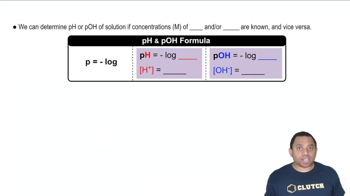
Step 2: For the strong acid HNO_3, calculate the pH directly from its concentration. Since HNO_3 is a strong acid, it dissociates completely, so [H^+] = 0.0650 M. Use the formula pH = -log[H^+].
Step 3: For the weak acid HNO_2, use the acid dissociation constant (K_a) to find [H^+]. Set up the equilibrium expression for the dissociation of HNO_2: HNO_2 ⇌ H^+ + NO_2^-. Use the expression K_a = [H^+][NO_2^-]/[HNO_2] and solve for [H^+]. Then calculate pH = -log[H^+].
Step 4: For the strong base KOH, calculate the pOH from its concentration. Since KOH is a strong base, it dissociates completely, so [OH^-] = 0.0195 M. Use the formula pOH = -log[OH^-], and then find pH using pH = 14 - pOH.
Step 5: For the salt CH_3NH_3I, determine the pH by considering the hydrolysis of CH_3NH_3^+. Write the hydrolysis reaction: CH_3NH_3^+ + H_2O ⇌ CH_3NH_2 + H_3O^+. Use the K_b of CH_3NH_2 to find K_a of CH_3NH_3^+ using K_w = K_a * K_b, and then calculate [H^+] to find pH.
Key Concepts
Here are the essential concepts you must grasp in order to answer the question correctly.
pH Scale
The pH scale measures the acidity or basicity of a solution, ranging from 0 to 14. A pH less than 7 indicates an acidic solution, while a pH greater than 7 indicates a basic solution. A pH of 7 is considered neutral. The scale is logarithmic, meaning each whole number change represents a tenfold change in hydrogen ion concentration.
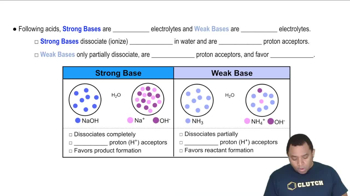
Strong acids, like HNO3, completely dissociate in water, contributing all their hydrogen ions to the solution, while weak acids, like HNO2, only partially dissociate. Similarly, strong bases, such as KOH, fully dissociate to provide hydroxide ions, whereas weak bases, like CH3NH3, do not fully dissociate. Understanding the strength of acids and bases is crucial for calculating pH accurately.
The concentration of hydrogen ions in a solution directly affects its pH. For strong acids, the pH can be calculated directly from the molarity of the acid, while for weak acids, the pH requires the use of the acid dissociation constant (Ka) to determine the concentration of hydrogen ions. For bases, the pOH can be calculated first, and then converted to pH using the relationship pH + pOH = 14.

 Verified step by step guidance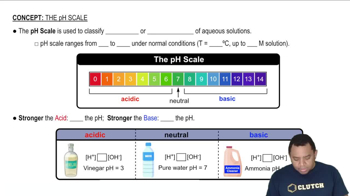
 02:33
02:33