Pearson+ LogoPearson+ Logo
Ch.21 - Transition Elements and Coordination Chemistry
McMurry - Chemistry 8th Edition
McMurry8th EditionChemistryISBN: 9781292336145Not the one you use?Change textbook
Chapter 21, Problem 21.118a

Draw a crystal field energy-level diagram, and predict the number of unpaired electrons for each of the following: 
(a) [Mn(H2O)6]2+

Verified step by step guidance
1
Identify the metal ion and its oxidation state. For [Mn(H2O)_6]^{2+}, manganese (Mn) is in the +2 oxidation state.
Determine the electron configuration of the Mn^{2+} ion. Manganese in its elemental form is [Ar] 3d^5 4s^2, so Mn^{2+} is [Ar] 3d^5.
Recognize that [Mn(H2O)_6]^{2+} is an octahedral complex, which means the 3d orbitals will split into two sets: t_{2g} (lower energy) and e_g (higher energy).
Distribute the 5 d-electrons of Mn^{2+} among the split d-orbitals according to Hund's rule, filling the lower energy t_{2g} orbitals first before pairing electrons in the higher energy e_g orbitals.
Count the number of unpaired electrons in the d-orbitals after distribution.

Verified video answer for a similar problem:

This video solution was recommended by our tutors as helpful for the problem above.
Was this helpful?

Key Concepts

Here are the essential concepts you must grasp in order to answer the question correctly.

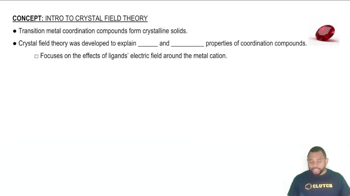
Crystal Field Theory

Crystal Field Theory (CFT) explains how the arrangement of ligands around a central metal ion affects its electronic structure and energy levels. It describes the splitting of d-orbitals in transition metal complexes due to the electrostatic interactions between the metal ion and surrounding ligands. This theory is crucial for predicting the magnetic properties and color of the complexes.
Recommended video:
Guided course
01:18
The study of ligand-metal interactions helped to form Ligand Field Theory which combines CFT with MO Theory.

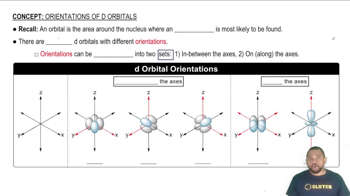
d-Orbital Splitting

In an octahedral field, the five d-orbitals split into two energy levels: the lower-energy t2g (dxy, dyz, dzx) and the higher-energy eg (dx2-y2, dz2) orbitals. The extent of this splitting depends on the nature of the ligands and their field strength. Understanding this splitting is essential for determining the electron configuration and the number of unpaired electrons in a complex.
Recommended video:
Guided course
02:06
d Orbital Orientations

Unpaired Electrons and Magnetism

Unpaired electrons in an atom or ion contribute to its magnetic properties. A species with unpaired electrons exhibits paramagnetism, while those with all paired electrons are diamagnetic. In the context of transition metal complexes, the number of unpaired electrons can be predicted from the electron configuration after considering d-orbital splitting, which is vital for understanding the complex's behavior in a magnetic field.
Recommended video:
Guided course
00:59
Magnetic Quantum Example
Related Practice
Textbook Question

For each of the following complexes, describe the bonding using valence bond theory. Include orbital diagrams for the free metal ion and the metal ion in the complex. Indicate which hybrid orbitals the metal ion uses for bonding, and specify the number of unpaired electrons. 

(a) [AuCl4]2 (square planar)

Textbook Question

What is the systematic name for each of the following ions?

(a) [MnCl4]2-

(b) [Ni(NH3)6]2+

Textbook Question

For each of the following complexes, draw a crystal field energy-level diagram, assign the electrons to orbitals, and predict the number of unpaired electrons.

(a) [Pt(NH3)4]2+ (square planar)

Textbook Question

Cobalt(III) trifluoroacetylacetonate, Co(tfac)3, is a sixc oordinate, octahedral metal chelate in which three planar, bidentate tfac ligands are attached to a central Co atom:

(a) Draw all possible diastereoisomers and enantiomers of Co(tfac)3.

Textbook Question

There are two possible [M(OH)4]- complexes of first-series transition metals that have three unpaired electrons.

(a) What are the oxidation state and the identity of M in these complexes?

(b) Using orbital diagrams, give a valence bond description of the bonding in each complex.

(c) Based on common oxidation states of first-series transition metals (Figure 21.6), which [M(OH)4]- complex is more likely to exist? 

<QUESTION REFERENCES FIGURE 21.6>-

Textbook Question

Tell how many diastereoisomers are possible for each of the following complexes, and draw their structures. 

(a) Pt(NH3)3Cl (square planar) 

(b) [FeBr2Cl2(en)]-