
Pearson+ LogoPearson+ Logo
Ch.21 - Transition Elements and Coordination Chemistry
McMurry - Chemistry 8th Edition
McMurry8th EditionChemistryISBN: 9781292336145Not the one you use?Change textbook
Chapter 21, Problem 21.79a

Assign a systematic name to each of the following ions.  
(a) [AuCl4]-
(b) [Fe(CN)6]4-

Verified step by step guidance
1
Identify the central metal atom in each complex ion. For (a), the central metal is Au (gold), and for (b), it is Fe (iron).
Determine the oxidation state of the central metal atom. For (a), consider the charge of the ligands (Cl is -1) and the overall charge of the ion (-1) to find the oxidation state of Au. For (b), consider the charge of the ligands (CN is -1) and the overall charge of the ion (-4) to find the oxidation state of Fe.
Name the ligands. For (a), the ligand is chloride, and for (b), the ligand is cyanide. Use the appropriate prefixes if there are multiple identical ligands (e.g., tetra- for four chloride ions).
Combine the ligand names with the metal name. For anionic complexes, the metal name ends with the suffix '-ate'. For (a), use 'aurate' for gold, and for (b), use 'ferrate' for iron.
Write the systematic name by placing the ligand names first, followed by the metal name with its oxidation state in Roman numerals in parentheses.>

Verified video answer for a similar problem:

This video solution was recommended by our tutors as helpful for the problem above.
Was this helpful?

Key Concepts

Here are the essential concepts you must grasp in order to answer the question correctly.

Coordination Compounds

Coordination compounds consist of a central metal atom or ion bonded to surrounding molecules or ions, known as ligands. The nature of these ligands and their arrangement around the metal center significantly influence the properties and reactivity of the compound. Understanding the structure of coordination compounds is essential for naming them systematically.
Recommended video:
Guided course
01:32
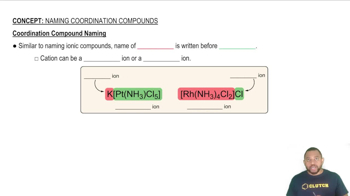
Coordination Compound Naming

Oxidation States

The oxidation state of an element in a compound indicates the degree of oxidation or reduction it has undergone. In coordination compounds, the oxidation state of the central metal ion is crucial for determining the systematic name. For example, in [AuCl4]-, gold has an oxidation state of +3, which is important for naming the ion correctly.
Recommended video:
Guided course
02:42
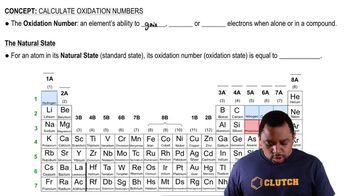
Oxidation Numbers

IUPAC Nomenclature

The International Union of Pure and Applied Chemistry (IUPAC) provides systematic rules for naming chemical compounds, including coordination complexes. The naming convention involves identifying the ligands, their quantities, and the oxidation state of the metal. For instance, in [Fe(CN)6]4-, the complex is named hexacyanoferrate(II) based on these rules.
Recommended video:
Guided course
02:39
Rules for Naming Alkanes
Related Practice
Textbook Question

Cobalt(III) trifluoroacetylacetonate, Co(tfac)3, is a sixc oordinate, octahedral metal chelate in which three planar, bidentate tfac ligands are attached to a central Co atom:

(a) Draw all possible diastereoisomers and enantiomers of Co(tfac)3.

Textbook Question

There are two possible [M(OH)4]- complexes of first-series transition metals that have three unpaired electrons.

(a) What are the oxidation state and the identity of M in these complexes?

(b) Using orbital diagrams, give a valence bond description of the bonding in each complex.

(c) Based on common oxidation states of first-series transition metals (Figure 21.6), which [M(OH)4]- complex is more likely to exist? 

<QUESTION REFERENCES FIGURE 21.6>-

Textbook Question

Tell how many diastereoisomers are possible for each of the following complexes, and draw their structures. 

(a) Pt(NH3)3Cl (square planar) 

(b) [FeBr2Cl2(en)]-

Textbook Question

Two first-series transition metals have three unpaired electrons in complex ions of the type [MCl4]2-.

(a) What are the oxidation state and the identity of M in these complexes?

(b) Draw valence bond orbital diagrams for the two possible ions.

(c) Based on common oxidation states of first-series transition metals (Figure 21.6), which ion is more likely to exist?

<QUESTION REFERENCES FIGURE 21.6>

Textbook Question

Constitutional isomers of a ruthenium(II) coordination compound are shown below.

(a) Give the formula and name for structures 1-3.

(b) Which structures are linkage isomers? 

(c) Which structures are ionization isomers?

Textbook Question

Look at the location in the periodic table of elements A, B, C, and D. What is the electron configuration of the transition metal in each of the following ions?  

(a) A2+

(b) B+