
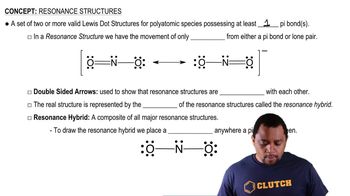
Consider the formate ion, HCO2-, which is the anion formed when formic acid loses an H+ ion. The H and the two O atoms are bonded to the central C atom. (c) Would you predict that the C—O bond lengths in the formate ion would be longer or shorter relative to those in CO2?
Consider the formate ion, HCO2-, which is the anion formed when formic acid loses an H+ ion. The H and the two O atoms are bonded to the central C atom. (b) Are resonance structures needed to describe the structure?
Verified step by step guidance
Verified video answer for a similar problem:
Key Concepts
Resonance Structures
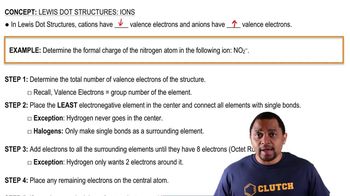
Lewis Structures
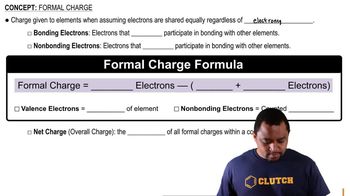
Formal Charge
For each of the following molecules or ions of sulfur and oxygen, write a single Lewis structure that obeys the octet rule, and calculate the oxidation numbers and formal charges on all the atoms: (a) SO2 Write a single Lewis structure that obeys the octet rule for SO2 and assign the formal charges on all the atoms. (b) SO3 Write a single Lewis structure that obeys the octet rule for SO3 and assign the formal charges on all the atoms. (c) SO32- Write a single Lewis structure that obeys the octet rule for SO32- and assign the formal charges on all the atoms.
(b) With what allotrope of oxygen is it isoelectronic?
(c) What would you predict for the lengths of the bonds in NO2- relative to N¬O single bonds and double bonds?
Predict the ordering, from shortest to longest, of the bond lengths in CO, CO2, and CO32- .
Based on Lewis structures, predict the ordering, from shortest to longest, of N¬O bond lengths in NO+, NO2-, and NO3-.
