The following data compare the standard enthalpies and free energies of formation of some crystalline ionic substances and aqueous solutions of the substances:
(a) Write the formation reaction for AgNO31s2. Based on this reaction, do you expect the entropy of the system to increase or decrease upon the formation of AgNO31s2? (b) Use ΔH°f and ΔG°f of AgNO31s2 to determine the entropy change upon formation of the substance. Is your answer consistent with your reasoning in part (a)?
Verified step by step guidance
1
Write the formation reaction for AgNO3(s) from its elements in their standard states. The formation reaction typically involves the reactants (elements in their standard states) combining to form the product (compound). For AgNO3(s), the reaction would be: Ag(s) + 1/2 N2(g) + 3/2 O2(g) → AgNO3(s).
Analyze the entropy change based on the formation reaction. Entropy, a measure of disorder or randomness, tends to increase when gases are involved in the reactants and decrease when they form a solid. In this reaction, gaseous nitrogen and oxygen are used to form a solid, suggesting a decrease in entropy.
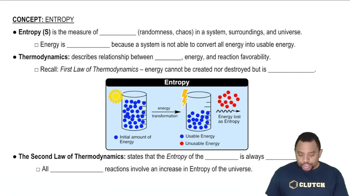
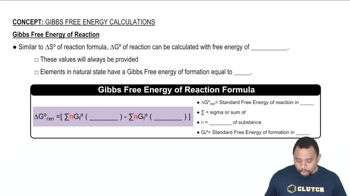
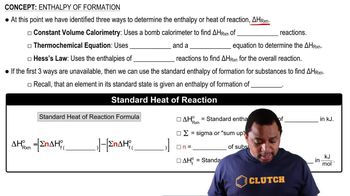
Use the standard enthalpy of formation (ΔH°f) and the standard free energy of formation (ΔG°f) to calculate the entropy change (ΔS°) upon formation of AgNO3(s). The relationship between these quantities is given by the equation ΔG° = ΔH° - TΔS°, where T is the temperature in Kelvin.
Rearrange the equation to solve for ΔS°: ΔS° = (ΔH° - ΔG°) / T. Plug in the values of ΔH°f and ΔG°f for AgNO3(s) at a specific temperature (usually 298 K) to calculate ΔS°.
Compare the calculated ΔS° with the qualitative analysis from step 2. If ΔS° is negative, it confirms that the entropy decreases, consistent with the expectation from the formation reaction where gases form a solid.
Verified video answer for a similar problem:
This video solution was recommended by our tutors as helpful for the problem above.
Video duration:
4m
Play a video:
0 Comments
Was this helpful?
Key Concepts
Here are the essential concepts you must grasp in order to answer the question correctly.
Formation Reaction
A formation reaction is a chemical reaction that produces one mole of a compound from its constituent elements in their standard states. For AgNO3(s), the formation reaction can be represented as: Ag(s) + 1/2 N2(g) + 3/2 O2(g) → AgNO3(s). Understanding this reaction is crucial for analyzing the thermodynamic properties associated with the formation of the compound.
Entropy is a measure of the disorder or randomness in a system. When a solid forms from its gaseous or liquid components, the entropy typically decreases due to the more ordered arrangement of particles in the solid state. In the case of AgNO3(s), one must consider the states of the reactants and products to predict whether the entropy will increase or decrease during its formation.
Gibbs Free Energy (ΔG) combines enthalpy (ΔH) and entropy (ΔS) to determine the spontaneity of a reaction at constant temperature and pressure, expressed as ΔG = ΔH - TΔS. By using the standard enthalpy and free energy of formation for AgNO3(s), one can calculate the entropy change (ΔS) during its formation. This calculation helps confirm whether the initial reasoning about entropy change was correct.


 02:34
02:34