Skip to main content
General Chemistry
My Course
Learn
Exam Prep
AI Tutor
Study Guides
Textbook Solutions
Flashcards
Explore
My Course
Learn
Exam Prep
AI Tutor
Study Guides
Textbook Solutions
Flashcards
Explore
Back
Titrations: Weak Base-Strong Acid definitions
You can tap to flip the card.
Titration
You can tap to
flip the card.
👆
Titration
A laboratory method to determine the concentration of a solute in a solution by adding a titrant of known concentration.
Track progress
Control buttons has been changed to "navigation" mode.
1/11
Related practice
Recommended videos
Guided course
01:41
Before the Equivalence Point
Jules
Guided course
05:10
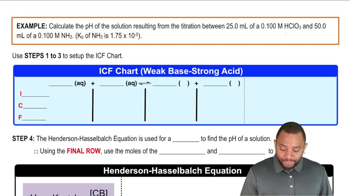
pH Before the Equivalence Point Example
Jules
Guided course
01:08
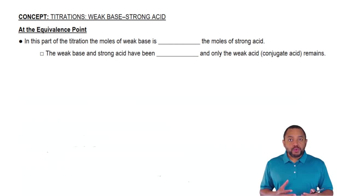
At the Equivalence Point
Jules
Terms in this set (11)
Hide definitions
Titration
A laboratory method to determine the concentration of a solute in a solution by adding a titrant of known concentration.
Weak Base
A base that does not completely ionize in solution, resulting in a higher pH than a strong base.
Strong Acid
An acid that completely ionizes in solution, significantly lowering the pH.
Equivalence Point
The stage in titration where the moles of acid equal the moles of base, resulting in neutralization.
Buffer
A solution that resists changes in pH when small amounts of acid or base are added.
Henderson-Hasselbalch Equation
An equation used to calculate the pH of a buffer solution using the concentration of acid and its conjugate base.
ICF Chart
A tool used to track the initial, change, and final amounts of reactants and products in a chemical reaction.
Molarity
A measure of the concentration of a solute in a solution, expressed as moles of solute per liter of solution.
Conjugate Acid
The species formed when a base gains a proton, often present in buffer solutions.
Neutralization
A chemical reaction in which an acid and a base react to form water and a salt, resulting in a neutral pH.
Ionization
The process by which an atom or molecule gains or loses electrons to form ions, affecting pH.
 Back
Back
 Back
Back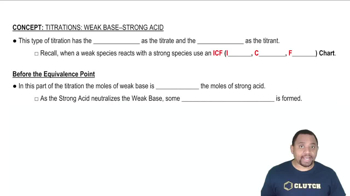
 01:41
01:41