Skip to main content
General Chemistry
My Course
Learn
Exam Prep
AI Tutor
Study Guides
Textbook Solutions
Flashcards
Explore
My Course
Learn
Exam Prep
AI Tutor
Study Guides
Textbook Solutions
Flashcards
Explore
Back
Titrations: Diprotic & Polyprotic Buffers definitions
You can tap to flip the card.
Diprotic Acid
You can tap to
flip the card.
👆
Diprotic Acid
An acid with two acidic hydrogens, each dissociating with a unique Ka value.
Track progress
Control buttons has been changed to "navigation" mode.
1/15
Related practice
Recommended videos
Guided course
03:13
Diprotic Buffers
Jules
Guided course
06:07
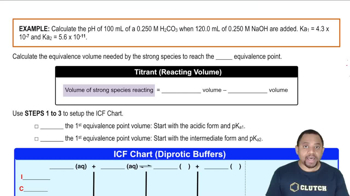
Diprotic Buffer Titration Example
Jules
Guided course
03:25
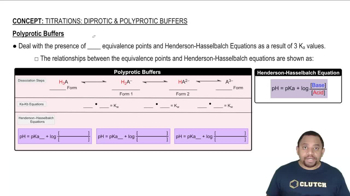
Polyprotic Buffers
Jules
Terms in this set (15)
Hide definitions
Diprotic Acid
An acid with two acidic hydrogens, each dissociating with a unique Ka value.
Triprotic Acid
An acid with three acidic hydrogens, each dissociating with a unique Ka value.
Equivalence Point
The point in a titration where the amount of titrant equals the amount of substance in the sample.
Henderson-Hasselbalch Equation
An equation used to calculate pH, involving pKa and the ratio of base to acid.
Conjugate Base
The species formed when an acid donates a proton.
Acid Ionization Constant (Ka)
A constant that measures the strength of an acid in solution.
Water Ion Product (Kw)
The product of the concentrations of hydrogen ions and hydroxide ions in water.
Intermediate Form
The form of an acid after losing one proton but before losing all acidic protons.
Basic Form
The form of an acid after losing all its acidic protons.
Ka1
The acid dissociation constant for the first dissociation step of a polyprotic acid.
Ka2
The acid dissociation constant for the second dissociation step of a diprotic acid.
Ka3
The acid dissociation constant for the third dissociation step of a triprotic acid.
Kb1
The base dissociation constant for the first protonation step of a polyprotic base.
Kb2
The base dissociation constant for the second protonation step of a diprotic base.
Kb3
The base dissociation constant for the third protonation step of a triprotic base.
 Back
Back
 Back
Back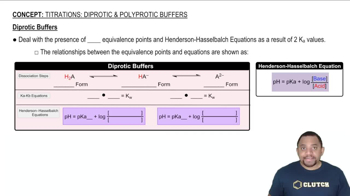
 03:13
03:13