Skip to main content
General Chemistry
My Course
Learn
Exam Prep
AI Tutor
Study Guides
Textbook Solutions
Flashcards
Explore
My Course
Learn
Exam Prep
AI Tutor
Study Guides
Textbook Solutions
Flashcards
Explore
Back
Third Law of Thermodynamics definitions
You can tap to flip the card.
Third Law of Thermodynamics
You can tap to
flip the card.
👆
Third Law of Thermodynamics
States that the entropy of a perfect crystal is zero at absolute zero temperature.
Track progress
Control buttons has been changed to "navigation" mode.
1/10
Related flashcards
Related practice
Recommended videos
Guided course
02:20
Entropy of Perfect Crystals
Jules
Guided course
01:11
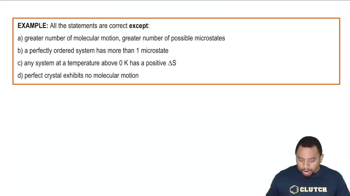
Third Law of Thermodynamics Example
Jules
Guided course
01:23
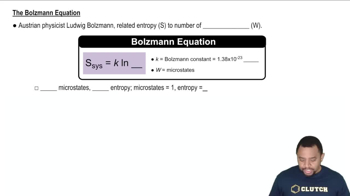
The Boltzmann Equation
Jules
Terms in this set (10)
Hide definitions
Third Law of Thermodynamics
States that the entropy of a perfect crystal is zero at absolute zero temperature.
Entropy
A measure of disorder in a system, linked to the number of possible microstates.
Perfect Crystal
A solid with a regular and ideal internal atomic arrangement at 0 Kelvin.
Absolute Zero
The lowest possible temperature, 0 Kelvin, where atomic motion ceases.
Microstate
The number of possible energetic arrangements of a system's components.
Boltzmann Equation
Relates entropy to microstates using the formula S = k ln(W).
Boltzmann Constant
A constant (1.38 x 10^-23 J/K) used in the Boltzmann equation to calculate entropy.
Kelvin
The SI unit of temperature, where 0 Kelvin is absolute zero.
Ludwig Boltzmann
Austrian physicist who formulated the equation relating entropy to microstates.
Disorder
The degree of randomness or chaos in a system, associated with higher entropy.
 Back
Back
 Back
Back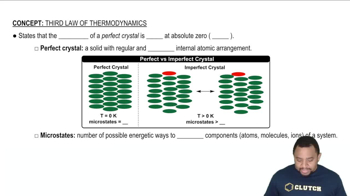
 02:20
02:20