Skip to main content
General Chemistry
My Course
Learn
Exam Prep
AI Tutor
Study Guides
Textbook Solutions
Flashcards
Explore
My Course
Learn
Exam Prep
AI Tutor
Study Guides
Textbook Solutions
Flashcards
Explore
Back
The pH Scale definitions
You can tap to flip the card.
pH Scale
You can tap to
flip the card.
👆
pH Scale
A scale from 0 to 14 measuring acidity or basicity of solutions at 25°C and 1 molarity.
Track progress
Control buttons has been changed to "navigation" mode.
1/15
Related flashcards
Related practice
Recommended videos
Guided course
02:33
The pH Scale
Jules
Guided course
00:48
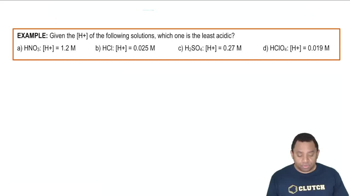
Least Acidic Solution Example
Jules
Guided course
02:09
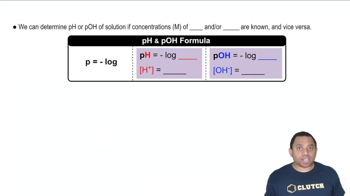
pH and pOH Calculations
Jules
Terms in this set (15)
Hide definitions
pH Scale
A scale from 0 to 14 measuring acidity or basicity of solutions at 25°C and 1 molarity.
Acidity
A property of solutions with pH below 7, indicating higher H+ concentration.
Basicity
A property of solutions with pH above 7, indicating higher OH- concentration.
Neutral
A state where pH is 7, with equal concentrations of H+ and OH- ions.
Hydrogen Ion
A positively charged ion, H+, whose concentration determines acidity.
Hydroxide Ion
A negatively charged ion, OH-, whose concentration determines basicity.
Molarity
A measure of solute concentration, typically in moles per liter.
Inverse Logarithm
A mathematical operation used to find ion concentration from pH or pOH.
Room Temperature
Standard condition of 25°C used in pH scale measurements.
Vinegar
An example of an acidic solution with a pH around 3.
Ammonia Cleaner
An example of a basic solution with a pH around 12.
pOH
A measure of hydroxide ion concentration, calculated as -log[OH-].
Hydronium Ion
A form of H+ in water, contributing to acidity.
Logarithm
A mathematical function used in calculating pH and pOH.
Equation
pH + pOH = 14, relating acidity and basicity under standard conditions.
 Back
Back
 Back
Back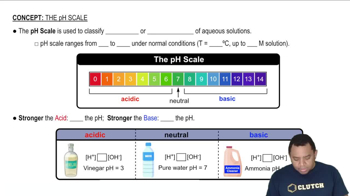
 02:33
02:33