Skip to main content
General Chemistry
My Course
Learn
Exam Prep
AI Tutor
Study Guides
Textbook Solutions
Flashcards
Explore
My Course
Learn
Exam Prep
AI Tutor
Study Guides
Textbook Solutions
Flashcards
Explore
Back
The Ideal Gas Law Derivations definitions
You can tap to flip the card.
Ideal Gas Law
You can tap to
flip the card.
👆
Ideal Gas Law
A fundamental equation in chemistry, PV=nRT, used to predict the behavior of gases under various conditions.
Track progress
Control buttons has been changed to "navigation" mode.
1/10
Related practice
Recommended videos
Guided course
00:47
Ideal Gas Law Derivations
Jules
Guided course
04:51
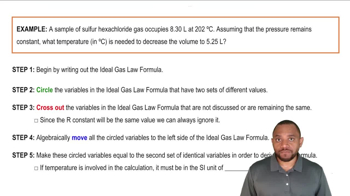
The Ideal Gas Law Derivations Example
Jules
Terms in this set (10)
Hide definitions
Ideal Gas Law
A fundamental equation in chemistry, PV=nRT, used to predict the behavior of gases under various conditions.
Pressure
The force exerted by gas particles per unit area on the walls of its container.
Volume
The amount of space occupied by a gas, typically measured in liters or cubic meters.
Moles
A measure of the amount of substance, representing a specific number of particles, usually atoms or molecules.
Temperature
A measure of the average kinetic energy of gas particles, affecting their speed and energy.
Derivation
The process of rearranging equations to solve for unknown variables under different conditions.
Variables
Quantities that can change or vary, such as pressure, volume, temperature, and moles in gas equations.
Equation
A mathematical statement that shows the equality of two expressions, used to describe gas behavior.
Conditions
Specific states or circumstances affecting gas behavior, such as temperature and pressure.
Predictions
Forecasts or estimations of gas behavior based on mathematical models and equations.
 Back
Back
 Back
Back
 00:47
00:47