Skip to main content
General Chemistry
My Course
Learn
Exam Prep
AI Tutor
Study Guides
Textbook Solutions
Flashcards
Explore
My Course
Learn
Exam Prep
AI Tutor
Study Guides
Textbook Solutions
Flashcards
Explore
Back
The Electron Configuration Review definitions
You can tap to flip the card.
Electron Configuration
You can tap to
flip the card.
👆
Electron Configuration
Represents the distribution of electrons in an atom's orbitals, following a specific sequence.
Track progress
Control buttons has been changed to "navigation" mode.
1/15
Related practice
Recommended videos
Guided course
01:32
Ground State Electron Configurations
Jules
Guided course
03:04
Auf Bau Principle
Jules
Guided course
01:33
The Electron Configuration Example
Jules
Terms in this set (15)
Hide definitions
Electron Configuration
Represents the distribution of electrons in an atom's orbitals, following a specific sequence.
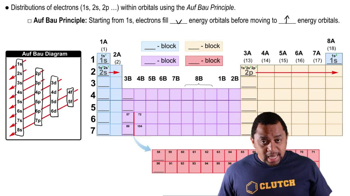
Aufbau Principle
Electrons fill lower energy orbitals before occupying higher energy ones.
Orbital
A region in an atom where there is a high probability of finding electrons.
Periodic Table
A tabular arrangement of elements, organized by increasing atomic number and electron configuration.
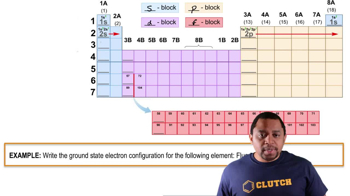
S Block
Part of the periodic table where elements have their outermost electrons in s orbitals.
P Block
Part of the periodic table where elements have their outermost electrons in p orbitals.
D Block
Part of the periodic table where elements have their outermost electrons in d orbitals.
F Block
Part of the periodic table where elements have their outermost electrons in f orbitals.
Condensed Electron Configuration
A shorthand notation using the last noble gas to simplify electron arrangements.
Noble Gas
Elements in group 18 of the periodic table, used as reference points in electron configurations.
Ground State
The lowest energy state of an atom, with electrons in the lowest possible orbitals.
Sublevel
A division of electron shells in an atom, consisting of orbitals of the same energy level.
Energy Level
The fixed amount of energy that a system described by quantum mechanics can have.
Electron
A subatomic particle with a negative charge, found in orbitals around an atom's nucleus.
Ion
An atom or molecule with a net electric charge due to the loss or gain of one or more electrons.
 Back
Back
 Back
Back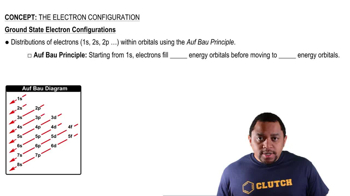
 01:32
01:32