Skip to main content
General Chemistry
My Course
Learn
Exam Prep
AI Tutor
Study Guides
Textbook Solutions
Flashcards
Explore
My Course
Learn
Exam Prep
AI Tutor
Study Guides
Textbook Solutions
Flashcards
Explore
Back
Subatomic Particles definitions
You can tap to flip the card.
Subatomic Particles
You can tap to
flip the card.
👆
Subatomic Particles
Fundamental components of an atom, including neutrons, protons, and electrons.
Track progress
Control buttons has been changed to "navigation" mode.
1/14
Related flashcards
Related practice
Recommended videos
Guided course
05:19
Subatomic Particles
Jules
Guided course
03:31
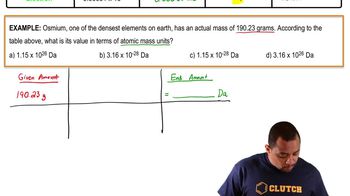
Atomic Mass Unit Example
Jules
1
views
Terms in this set (14)
Hide definitions
Subatomic Particles
Fundamental components of an atom, including neutrons, protons, and electrons.
Neutrons
Neutral particles in an atom's nucleus, slightly heavier than protons.
Protons
Positively charged particles in an atom's nucleus, similar in mass to neutrons.
Electrons
Negatively charged particles with much less mass than protons or neutrons.
Nucleus
Central part of an atom containing protons and neutrons, accounting for most of its mass.
Atomic Mass Unit
Unit of mass equal to 1/12 the mass of a carbon-12 atom, also known as Dalton.
Dalton
Alternative name for atomic mass unit, named after John Dalton.
Coulombs
Unit of electric charge, used to express the actual charge of protons and electrons.
Relative Mass
Mass of subatomic particles expressed in atomic mass units for comparison.
Relative Charge
Charge of subatomic particles expressed as +1, 0, or -1 for protons, neutrons, and electrons.
Actual Mass
Mass of subatomic particles measured in kilograms.
Actual Charge
Charge of subatomic particles measured in coulombs.
Carbon-12
Isotope of carbon used as a reference for defining atomic mass units.
John Dalton
Chemist known for his work on atomic theory, after whom the Dalton unit is named.
 Back
Back
 Back
Back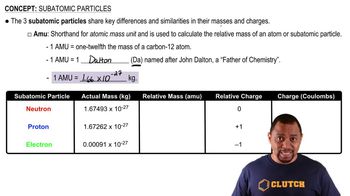
 05:19
05:19