Skip to main content
General Chemistry
My Course
Learn
Exam Prep
AI Tutor
Study Guides
Textbook Solutions
Flashcards
Explore
My Course
Learn
Exam Prep
AI Tutor
Study Guides
Textbook Solutions
Flashcards
Explore
Back
Stoichiometric Rate Calculations definitions
You can tap to flip the card.
Stoichiometric Rate Calculations
You can tap to
flip the card.
👆
Stoichiometric Rate Calculations
Determining the rate of one compound's formation or decomposition using another's rate and stoichiometric coefficients.
Track progress
Control buttons has been changed to "navigation" mode.
1/10
Related practice
Recommended videos
Guided course
02:28
Stoichiometric Rate Calculations
Jules
Terms in this set (10)
Hide definitions
Stoichiometric Rate Calculations
Determining the rate of one compound's formation or decomposition using another's rate and stoichiometric coefficients.
Rate-to-Rate Comparison
A method to compare the rates of two compounds using their stoichiometric coefficients in a balanced equation.
Stoichiometric Coefficients
Numbers in a balanced chemical equation indicating the ratio of moles of each substance involved.
Decomposition Rate
The speed at which a compound breaks down into simpler substances, measured in molarity per minute.
Formation Rate
The speed at which a compound is produced in a reaction, typically measured in molarity per minute.
Balanced Chemical Equation
An equation with equal numbers of each type of atom on both sides, reflecting the conservation of mass.
Molarity
A concentration unit representing moles of solute per liter of solution.
Nitrogen Gas
A diatomic molecule, N2, often involved in chemical reactions as a product or reactant.
H2
Molecular hydrogen, a diatomic molecule often involved in reactions as a reactant or product.
Mole-to-Mole Comparison
A stoichiometric method comparing moles of reactants and products using coefficients from a balanced equation.
 Back
Back
 Back
Back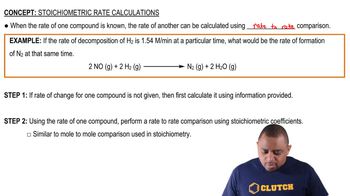
 02:28
02:28