Skip to main content
General Chemistry
My Course
Learn
Exam Prep
AI Tutor
Study Guides
Textbook Solutions
Flashcards
Explore
My Course
Learn
Exam Prep
AI Tutor
Study Guides
Textbook Solutions
Flashcards
Explore
Back
Intro to Chemical Kinetics quiz
You can tap to flip the card.
What does chemical kinetics study?
You can tap to
flip the card.
👆
What does chemical kinetics study?
Chemical kinetics studies the factors affecting the rate at which reactants are converted into products.
Track progress
Control buttons has been changed to "navigation" mode.
1/10
Related flashcards
Related practice
Recommended videos
Guided course
03:06
Chemical Kinetics
Jules
Guided course
01:34
Chemical Kinetics Example
Jules
Terms in this set (10)
Hide definitions
What does chemical kinetics study?
Chemical kinetics studies the factors affecting the rate at which reactants are converted into products.
How is reaction rate defined in chemical kinetics?
Reaction rate is defined by the change in concentration of reactants or products over time.
What does a faster reaction rate indicate?
A faster reaction rate indicates the formation of more products in a given time frame.
What happens to reaction rates as reactant concentrations decrease?
Reaction rates decrease as reactant concentrations diminish over time.
What signifies a reaction that goes to completion?
A single arrow in the chemical equation signifies a reaction that goes to completion.
What happens when all reactants are converted to products?
When all reactants are converted to products, the reaction halts, setting a limit on product formation.
How is concentration represented in chemical kinetics?
Concentration is represented by square brackets around the chemical species.
What is the relationship between product formation and reaction rate?
More product formation in a given time indicates a faster reaction rate.
What does a slower reaction rate indicate?
A slower reaction rate indicates the formation of fewer products in a given time frame.
Why can't reactions go on forever?
Reactions can't go on forever because eventually all reactants will be gone, stopping the reaction.
 Back
Back
 Back
Back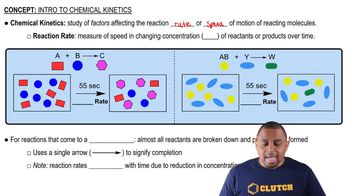
 03:06
03:06