Skip to main content
General Chemistry
My Course
Learn
Exam Prep
AI Tutor
Study Guides
Textbook Solutions
Flashcards
Explore
My Course
Learn
Exam Prep
AI Tutor
Study Guides
Textbook Solutions
Flashcards
Explore
Back
Periodic Trend: Successive Ionization Energies definitions
You can tap to flip the card.
Ionization Energy
You can tap to
flip the card.
👆
Ionization Energy
Energy required to remove an electron from a gaseous atom, forming a positively charged ion.
Track progress
Control buttons has been changed to "navigation" mode.
1/12
Related practice
Recommended videos
Guided course
01:48
Successive Ionizations
Jules
Guided course
00:39
Successive Ionizations Example
Jules
Guided course
02:22
Successive Ionization Energies
Jules
Terms in this set (12)
Hide definitions
Ionization Energy
Energy required to remove an electron from a gaseous atom, forming a positively charged ion.
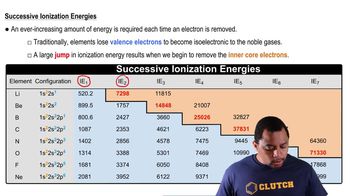
Successive Ionization Energies
Energy needed to remove additional electrons one at a time from an atom, increasing with each electron removed.
Valence Electrons
Electrons in the outermost shell of an atom, typically involved in forming bonds.
Inner Core Electrons
Electrons located in inner shells of an atom, requiring significantly more energy to remove.
Noble Gas Configuration
Stable electron arrangement resembling that of noble gases, often achieved by losing or gaining electrons.
Lithium
Element in Group 1A, experiences a large ionization energy increase after losing its first electron.
Beryllium
Element in Group 2A, shows a significant ionization energy increase after losing two electrons.
Nitrogen
Element that becomes more positively charged with each electron removed, requiring more energy.
Oxygen
Element that would experience a large ionization energy increase after losing six electrons.
Isoelectronic
Having the same number of electrons or the same electronic structure as another atom or ion.
Electron Removal
Process of taking away electrons from an atom, increasing its positive charge and ionization energy.
Energy Jump
Significant increase in ionization energy when removing inner core electrons after valence electrons.
 Back
Back
 Back
Back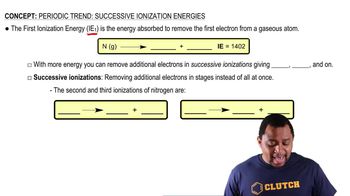
 01:48
01:48