Skip to main content
General Chemistry
My Course
Learn
Exam Prep
AI Tutor
Study Guides
Textbook Solutions
Flashcards
Explore
My Course
Learn
Exam Prep
AI Tutor
Study Guides
Textbook Solutions
Flashcards
Explore
Back
Periodic Trend: Ionic Radius definitions
You can tap to flip the card.
Ionic Radius
You can tap to
flip the card.
👆
Ionic Radius
Distance from an ion's nucleus to its outermost electron shell, influenced by the number of electrons.
Track progress
Control buttons has been changed to "navigation" mode.
1/10
Related practice
Recommended videos
Guided course
02:47
Ionic Radius
Jules
Guided course
01:32
Ionic Radius Example
Jules
Guided course
03:07
Ranking Ionic Radii
Jules
Terms in this set (10)
Hide definitions
Ionic Radius
Distance from an ion's nucleus to its outermost electron shell, influenced by the number of electrons.
Cation
A positively charged ion that is smaller than its neutral atom due to loss of valence electrons.
Anion
A negatively charged ion that is larger than its neutral atom due to gain of electrons.
Electron Shell
The orbit followed by electrons around an atom's nucleus, determining the atom's size.
Valence Electron
An electron in the outer shell of an atom, involved in forming bonds and determining ionic size.
Electron-Electron Repulsion
The force that increases ionic radius when additional electrons are added to an ion.
Periodic Trend
A pattern observed in the periodic table, such as changes in ionic radius with electron count.
Neutral Atom
An atom with no net charge, having equal numbers of protons and electrons.
Lithium Ion
A cation formed by losing one electron, resulting in a smaller size than the neutral lithium atom.
Oxide Ion
An anion formed by gaining two electrons, resulting in a larger size than the neutral oxygen atom.
 Back
Back
 Back
Back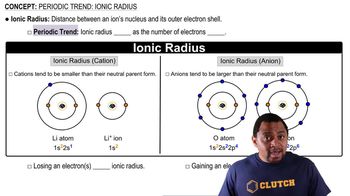
 02:47
02:47