Skip to main content
General Chemistry
My Course
Learn
Exam Prep
AI Tutor
Study Guides
Textbook Solutions
Flashcards
Explore
My Course
Learn
Exam Prep
AI Tutor
Study Guides
Textbook Solutions
Flashcards
Explore
Back
Periodic Trend: Effective Nuclear Charge definitions
You can tap to flip the card.
Effective Nuclear Charge
You can tap to
flip the card.
👆
Effective Nuclear Charge
Net attractive force on an electron from the nucleus, accounting for electron repulsion.
Track progress
Control buttons has been changed to "navigation" mode.
1/15
Related practice
Recommended videos
Guided course
01:51
Effective Nuclear Charge
Jules
Guided course
01:12
Effective Nuclear Charge Trends
Jules
Guided course
00:57
Effective Nuclear Charge Example
Jules
Terms in this set (15)
Hide definitions
Effective Nuclear Charge
Net attractive force on an electron from the nucleus, accounting for electron repulsion.
Shielding Effect
Reduction in nuclear attraction on an electron due to repulsion by inner electrons.
Valence Electrons
Electrons in the outermost shell of an atom, involved in chemical bonding.
Atomic Number
Number of protons in an atom's nucleus, determining its element.
Shielding Constant
Number of inner electrons reducing the effective nuclear charge on valence electrons.
Periodic Trend
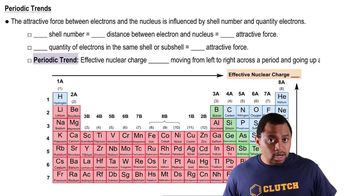
Pattern observed in the periodic table, such as increasing effective nuclear charge across periods.
Principal Quantum Number
Symbolized as n, it indicates the shell number of an electron in an atom.
Electron Configuration
Distribution of electrons in an atom's orbitals, e.g., 1s2 2s2 2p6.
Protons
Positively charged particles in an atom's nucleus, contributing to atomic number.
Nucleus
Central part of an atom containing protons and neutrons, positively charged.
Repulsion
Force pushing electrons apart due to their negative charges.
Attraction
Force pulling electrons towards the positively charged nucleus.
Shell Number
Indicates the energy level of electrons in an atom, related to distance from nucleus.
Core Electrons
Electrons in inner shells, not involved in bonding, contributing to shielding.
Subshell
Division of electron shells, designated as s, p, d, f, with specific shapes and capacities.
 Back
Back
 Back
Back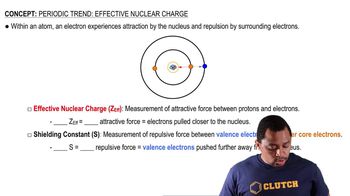
 01:51
01:51