Skip to main content
General Chemistry
My Course
Learn
Exam Prep
AI Tutor
Study Guides
Textbook Solutions
Flashcards
Explore
My Course
Learn
Exam Prep
AI Tutor
Study Guides
Textbook Solutions
Flashcards
Explore
Back
Periodic Trend: Atomic Radius definitions
You can tap to flip the card.
Atomic Radius
You can tap to
flip the card.
👆
Atomic Radius
The distance from an atom's nucleus to its outermost electron shell.
Track progress
Control buttons has been changed to "navigation" mode.
1/15
Related practice
Recommended videos
Guided course
02:02
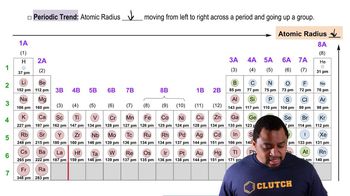
Atomic Radius
Jules
Guided course
01:42
Atomic Radius Trends
Jules
Guided course
00:56
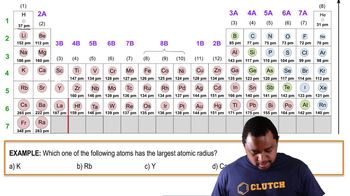
Atomic Radius Example
Jules
Terms in this set (15)
Hide definitions
Atomic Radius
The distance from an atom's nucleus to its outermost electron shell.
Nucleus
The central part of an atom containing protons and neutrons.
Protons
Positively charged particles found in an atom's nucleus.
Neutrons
Neutral particles found in an atom's nucleus.
Valence Shell
The outermost electron shell of an atom.
Electron Shells
Layers around an atom's nucleus where electrons are found.
Periodic Table
A tabular arrangement of elements ordered by atomic number.
Transition Metals
Elements in the d-block of the periodic table, often with variable oxidation states.
Inner Transition Metals
Elements in the f-block, including lanthanides and actinides.
Picometers
A unit of length equal to one trillionth of a meter, used to measure atomic radii.
Periodic Trend
A pattern observed in the periodic table, such as changes in atomic radius.
Electron Attraction
The force drawing electrons towards the nucleus, affecting atomic size.
Group
A column in the periodic table, where elements have similar properties.
Period
A row in the periodic table, where elements have increasing atomic numbers.
Synthesized Elements
Elements created in laboratories, often unstable with undefined properties.
 Back
Back
 Back
Back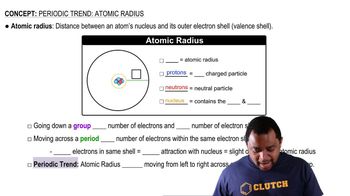
 02:02
02:02