Skip to main content
General Chemistry
My Course
Learn
Exam Prep
AI Tutor
Study Guides
Textbook Solutions
Flashcards
Explore
My Course
Learn
Exam Prep
AI Tutor
Study Guides
Textbook Solutions
Flashcards
Explore
Back
Periodic Table: Phases definitions
You can tap to flip the card.
Periodic Table
You can tap to
flip the card.
👆
Periodic Table
A tabular arrangement of chemical elements, organized by atomic number, electron configuration, and recurring properties.
Track progress
Control buttons has been changed to "navigation" mode.
1/15
Related practice
Recommended videos
Guided course
03:55
Element States of Matter
Jules
Guided course
02:07
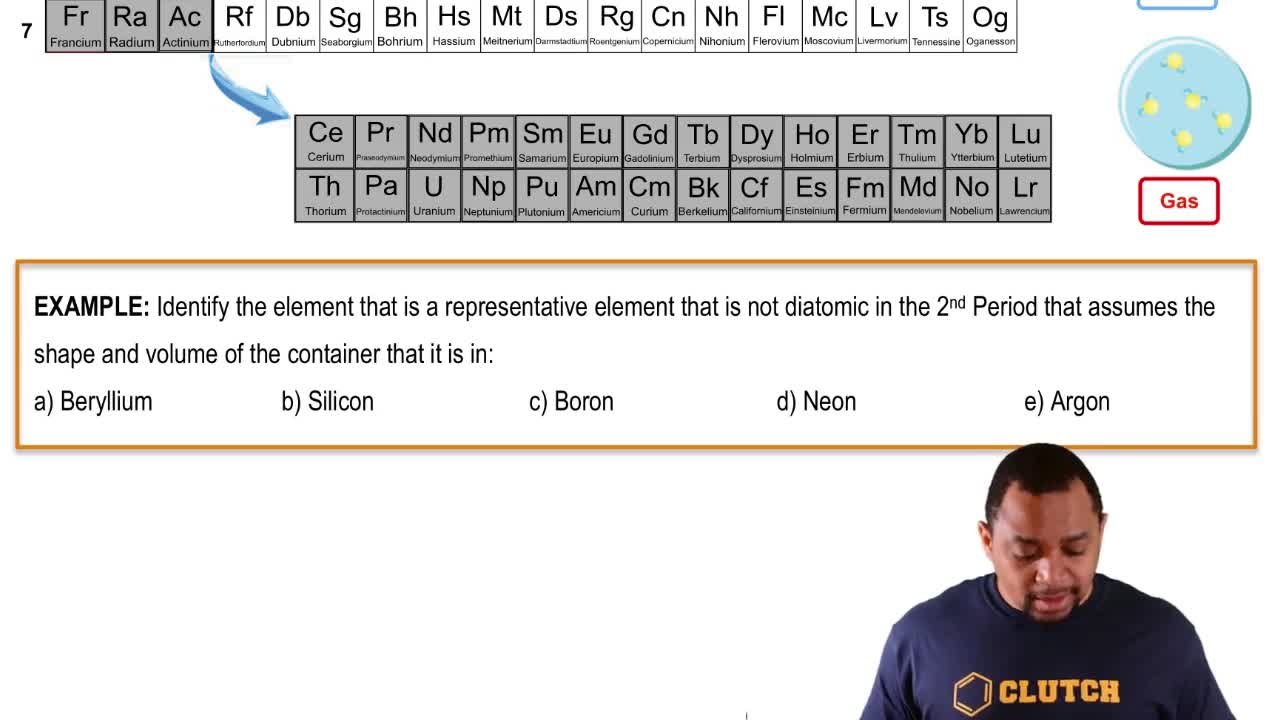
Second Period State of Matter Example
Jules
Terms in this set (15)
Hide definitions
Periodic Table
A tabular arrangement of chemical elements, organized by atomic number, electron configuration, and recurring properties.
States of Matter
The distinct forms that different phases of matter take on, namely solids, liquids, and gases.
Solids
A state of matter characterized by molecules that are closely packed and immobile, maintaining a fixed shape and volume.
Liquids
A state of matter where molecules are close but can move freely, conforming to the shape but not the volume of their container.
Gases
A state of matter with widely spaced molecules that assume both the shape and volume of their container.
Standard Temperature
A reference temperature of 25 degrees Celsius used to describe the state of elements.
Standard Pressure
A reference pressure of 1 atmosphere used to describe the state of elements.
Noble Gases
Elements in group 8A of the periodic table, known for being gases at standard conditions.
Mercury
A chemical element that is liquid at standard room temperature and pressure.
Bromine
A chemical element that is liquid at standard room temperature and pressure.
Synthetic Elements
Elements created in laboratories, often with high atomic numbers and unpredictable states at standard conditions.
Molecular Arrangement
The organization of molecules in a substance, influencing its state of matter.
Atomic Number
The number of protons in the nucleus of an atom, determining the element's position in the periodic table.
Electron Configuration
The distribution of electrons of an atom or molecule in atomic or molecular orbitals.
Unstable Elements
Elements with high atomic numbers that have unpredictable states due to their instability.
 Back
Back
 Back
Back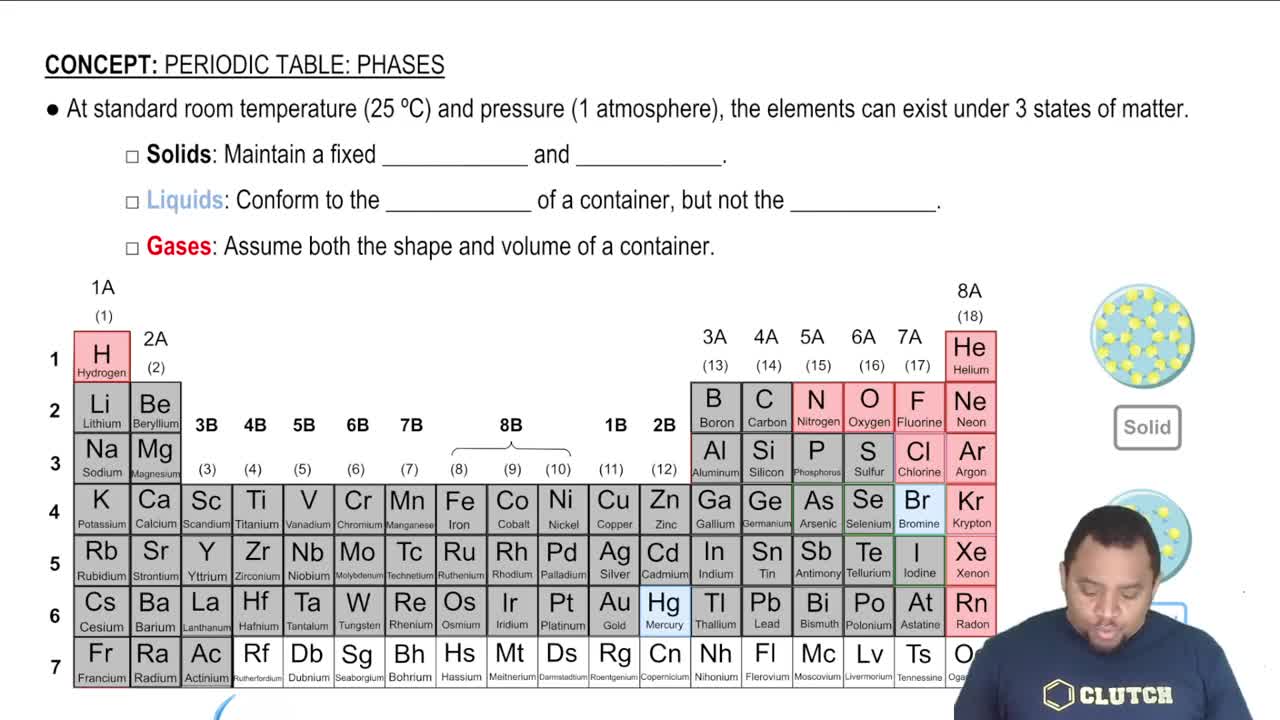
 03:55
03:55