Skip to main content
General Chemistry
My Course
Learn
Exam Prep
AI Tutor
Study Guides
Textbook Solutions
Flashcards
Explore
My Course
Learn
Exam Prep
AI Tutor
Study Guides
Textbook Solutions
Flashcards
Explore
Back
Paramagnetism and Diamagnetism definitions
You can tap to flip the card.
Pauli Exclusion Principle
You can tap to
flip the card.
👆
Pauli Exclusion Principle
A rule stating that an orbital can hold a maximum of two electrons with opposite spins.
Track progress
Control buttons has been changed to "navigation" mode.
1/10
Related practice
Recommended videos
Guided course
01:33
Paramagnetism vs Diamagnetism
Jules
Terms in this set (10)
Hide definitions
Pauli Exclusion Principle
A rule stating that an orbital can hold a maximum of two electrons with opposite spins.
Paramagnetic
A property of substances with at least one unpaired electron, making them responsive to magnetic fields.
Diamagnetic
A property of substances where all electrons are paired, rendering them unaffected by magnetic fields.
Orbital
A region in an atom where there is a high probability of finding electrons.
Electron Configuration
The arrangement of electrons in an atom's orbitals, crucial for determining magnetic properties.
Magnetic Field
An invisible field around magnetic materials and electric currents, influencing paramagnetic substances.
Unpaired Electron
An electron that occupies an orbital alone, contributing to paramagnetism.
Spin
A quantum property of electrons, with opposite spins allowing two electrons to occupy the same orbital.
S Orbital
A spherical orbital that can hold up to two electrons with opposite spins.
P Orbital
A dumbbell-shaped orbital that can hold up to six electrons, with potential for unpaired electrons.
 Back
Back
 Back
Back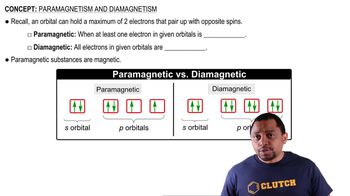
 01:33
01:33