Skip to main content
General Chemistry
My Course
Learn
Exam Prep
AI Tutor
Study Guides
Textbook Solutions
Flashcards
Explore
My Course
Learn
Exam Prep
AI Tutor
Study Guides
Textbook Solutions
Flashcards
Explore
Back
Nuclear Binding Energy definitions
You can tap to flip the card.
Nuclear Binding Energy
You can tap to
flip the card.
👆
Nuclear Binding Energy
Energy released during isotope formation or absorbed during its breakup, indicating nucleus stability.
Track progress
Control buttons has been changed to "navigation" mode.
1/10
Related practice
Recommended videos
Guided course
02:06
Nuclear Binding Energy
Jules
Guided course
03:50
Nuclear Binding Energy Example
Jules
Terms in this set (10)
Hide definitions
Nuclear Binding Energy
Energy released during isotope formation or absorbed during its breakup, indicating nucleus stability.
Mass Defect
Difference in mass between a nucleus and its constituent nucleons, crucial for energy calculations.
Isotope
Variant of an element with the same number of protons but different numbers of neutrons.
Nucleus
Central part of an atom, composed of protons and neutrons, determining atomic stability.
Radioisotope
Isotope with an unstable nucleus, undergoing radioactive decay to reach stability.
Joule
Unit of energy in the International System, equivalent to kilograms times meters squared per seconds squared.
Kilogram
Base unit of mass in the International System, used in energy calculations involving mass defect.
Speed of Light
Constant value of 3.00 x 10^8 meters per second, used in energy-mass conversion equations.
Einstein's Equation
Formula E=mc^2, relating mass defect to energy, fundamental in nuclear chemistry.
Stability
Condition of a nucleus being less likely to undergo radioactive decay, linked to binding energy.
 Back
Back
 Back
Back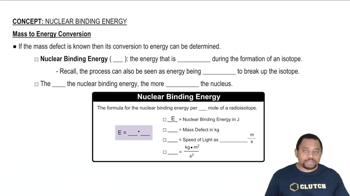
 02:06
02:06