Skip to main content
General Chemistry
My Course
Learn
Exam Prep
AI Tutor
Study Guides
Textbook Solutions
Flashcards
Explore
My Course
Learn
Exam Prep
AI Tutor
Study Guides
Textbook Solutions
Flashcards
Explore
Back
Molecular Formula definitions
You can tap to flip the card.
Molecular Formula
You can tap to
flip the card.
👆
Molecular Formula
Represents the actual number of atoms of each element in a compound.
Track progress
Control buttons has been changed to "navigation" mode.
1/10
Related flashcards
Related practice
Recommended videos
Guided course
02:08
Determining Molecular Formulas
Jules
Guided course
6:53
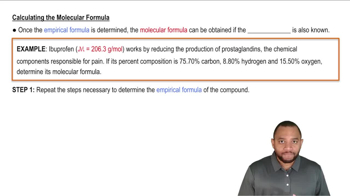
Molecular Formula Calculation Example
Jules
Terms in this set (10)
Hide definitions
Molecular Formula
Represents the actual number of atoms of each element in a compound.
Empirical Formula
Shows the simplest whole-number ratio of elements in a compound.
N Factor
A multiplier used to convert an empirical formula to a molecular formula.
Subscripts
Numbers in a chemical formula indicating the number of atoms of each element.
Glucose
A compound with the empirical formula CH2O and molecular formula C6H12O6.
Octane
A compound with the empirical formula C4H9 and molecular formula C8H18.
Salicylic Acid
A compound where the empirical and molecular formulas are identical.
Molar Mass
The mass of one mole of a substance, used to determine the n factor.
Compound
A substance formed from two or more elements chemically bonded together.
Elements
Substances consisting of atoms with the same number of protons.
 Back
Back
 Back
Back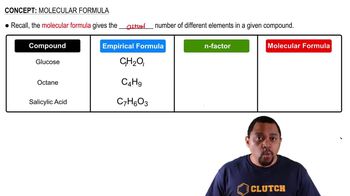
 02:08
02:08