Skip to main content
General Chemistry
My Course
Learn
Exam Prep
AI Tutor
Study Guides
Textbook Solutions
Flashcards
Explore
My Course
Learn
Exam Prep
AI Tutor
Study Guides
Textbook Solutions
Flashcards
Explore
Back
MO Theory: Bond Order definitions
You can tap to flip the card.
Bond Order
You can tap to
flip the card.
👆
Bond Order
Indicates the number of chemical bonds between a pair of atoms, affecting molecular stability and bond strength.
Track progress
Control buttons has been changed to "navigation" mode.
1/12
Related practice
Recommended videos
Guided course
01:29
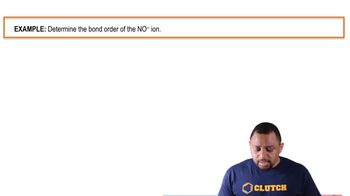
Bond Order Calculation
Jules
Guided course
02:04
Bond Order Example
Jules
Guided course
00:59
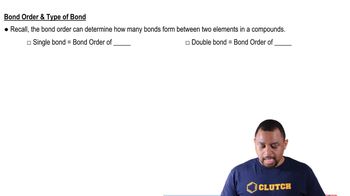
Bond Order and Type of Bond
Jules
Terms in this set (12)
Hide definitions
Bond Order
Indicates the number of chemical bonds between a pair of atoms, affecting molecular stability and bond strength.
Molecular Orbital Diagram
A visual representation used to distribute electrons into bonding and antibonding orbitals to determine bond order.
Bonding Electrons
Electrons located in molecular bonding orbitals that contribute to bond formation.
Antibonding Electrons
Electrons located in antibonding molecular orbitals that oppose bond formation.
Bond Strength
The measure of a bond's stability and resistance to breaking, increasing with higher bond order.
Bond Length
The distance between two bonded atoms, inversely related to bond strength.
Lewis Structure
A diagram showing the arrangement of electrons in a molecule, used to infer bond order visually.
Single Bond
A bond involving one pair of shared electrons, corresponding to a bond order of one.
Double Bond
A bond involving two pairs of shared electrons, corresponding to a bond order of two.
Triple Bond
A bond involving three pairs of shared electrons, corresponding to a bond order of three.
Stability
The likelihood of a molecule to exist without decomposing, related to bond order.
Chemical Bonds
Connections between atoms in a molecule, quantified by bond order.
 Back
Back
 Back
Back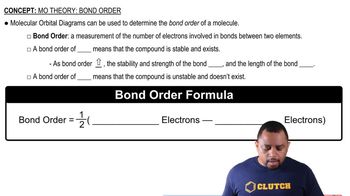
 01:29
01:29