Skip to main content
General Chemistry
My Course
Learn
Exam Prep
AI Tutor
Study Guides
Textbook Solutions
Flashcards
Explore
My Course
Learn
Exam Prep
AI Tutor
Study Guides
Textbook Solutions
Flashcards
Explore
Back
Mass Defect definitions
You can tap to flip the card.
Mass Defect
You can tap to
flip the card.
👆
Mass Defect
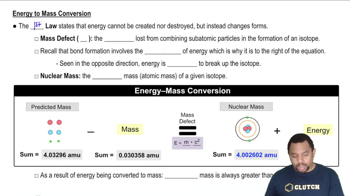
Difference between predicted mass of an isotope and its actual nuclear mass due to energy conversion.
Track progress
Control buttons has been changed to "navigation" mode.
1/15
Related practice
Recommended videos
Guided course
01:34
Calculating Predicted Mass
Jules
Guided course
01:35
Mass Defect Example
Jules
Guided course
04:12
Energy to Mass Conversion
Jules
Terms in this set (15)
Hide definitions
Mass Defect
Difference between predicted mass of an isotope and its actual nuclear mass due to energy conversion.
Predicted Mass
Sum of the masses of all subatomic particles in an element before isotope formation.
Nuclear Mass
Actual mass of an isotope's nucleus, found on the periodic table as atomic mass.
Subatomic Particles
Constituents of an atom, including neutrons, protons, and electrons.
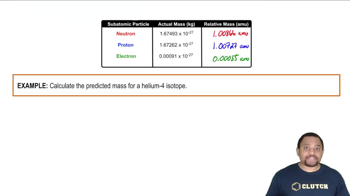
Neutron
Subatomic particle with a mass of 1.00866 amu, found in the nucleus.
Proton
Subatomic particle with a mass of 1.00727 amu, found in the nucleus.
Electron
Subatomic particle with a mass of 0.00055 amu, orbiting the nucleus.
Atomic Mass Unit
Unit of mass equal to 1.66 x 10^-27 kilograms, used for subatomic particles.
First Law of Thermodynamics
Principle stating energy cannot be created or destroyed, only transformed.
Energy Conversion
Process where mass lost during isotope formation is transformed into energy.
E=mc^2
Einstein's equation relating mass and energy, allowing conversion between the two.
Isotope
Variant of an element with a specific number of neutrons and protons in the nucleus.
Mass Number
Total number of protons and neutrons in an atom's nucleus.
Atomic Mass
Mass of an atom, typically found on the periodic table, representing nuclear mass.
Energy Absorption
Process where energy is used to break an isotope into its subatomic particles.
 Back
Back
 Back
Back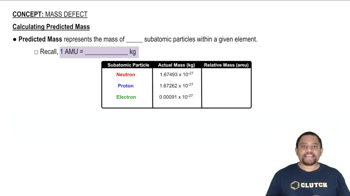
 01:34
01:34