Skip to main content
General Chemistry
My Course
Learn
Exam Prep
AI Tutor
Study Guides
Textbook Solutions
Flashcards
Explore
My Course
Learn
Exam Prep
AI Tutor
Study Guides
Textbook Solutions
Flashcards
Explore
Back
Limiting Reagent definitions
You can tap to flip the card.
Limiting Reagent
You can tap to
flip the card.
👆
Limiting Reagent
The reactant that is completely consumed in a reaction, determining the maximum amount of product formed.
Track progress
Control buttons has been changed to "navigation" mode.
1/13
Related flashcards
Related practice
Recommended videos
Guided course
01:30
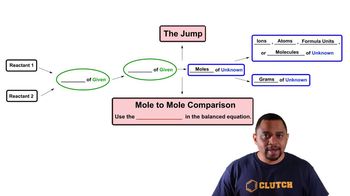
Limiting Reagent Concept
Jules
Guided course
01:34
Limiting Reagent in Reactions
Jules
Guided course
4:53
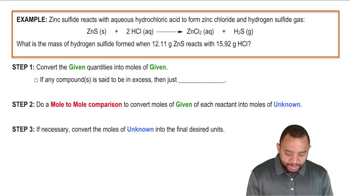
Limiting Reagent Example
Jules
Terms in this set (13)
Hide definitions
Limiting Reagent
The reactant that is completely consumed in a reaction, determining the maximum amount of product formed.
Theoretical Yield
The maximum amount of product that can be formed from a chemical reaction, assuming complete consumption of the limiting reagent.
Excess Reagent
The reactant that remains after the completion of the chemical reaction, not fully consumed.
Stoichiometry
The calculation of reactants and products in chemical reactions using balanced equations.
Chemical Equation
A representation of a chemical reaction showing the reactants and products with their respective amounts.
Moles
A unit of measurement for amount of substance, used in stoichiometry to relate quantities of reactants and products.
Grams
A unit of mass used to measure the amount of a substance in stoichiometric calculations.
Coefficients
Numbers in a balanced chemical equation that indicate the ratio of moles of reactants and products.
Ions
Charged particles formed when atoms gain or lose electrons, often involved in chemical reactions.
Atoms
The basic units of chemical elements, involved in forming molecules and compounds in reactions.
Formula Units
The lowest whole number ratio of ions in an ionic compound, used in stoichiometric calculations.
Molecules
Groups of atoms bonded together, representing the smallest fundamental unit of a chemical compound.
Balance Equation
An equation where the number of atoms for each element is equal on both sides, ensuring mass conservation.
 Back
Back
 Back
Back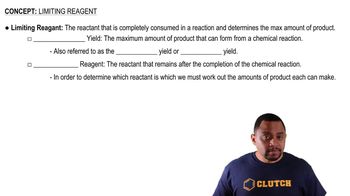
 01:30
01:30