Skip to main content
General Chemistry
My Course
Learn
Exam Prep
AI Tutor
Study Guides
Textbook Solutions
Flashcards
Explore
My Course
Learn
Exam Prep
AI Tutor
Study Guides
Textbook Solutions
Flashcards
Explore
Back
Lewis Dot Structures: Neutral Compounds definitions
You can tap to flip the card.
Lewis Dot Structure
You can tap to
flip the card.
👆
Lewis Dot Structure
A diagram showing the bonding between atoms and the lone pairs of electrons in a molecule.
Track progress
Control buttons has been changed to "navigation" mode.
1/15
Related practice
Recommended videos
Guided course
05:56
Lewis Dot Structures: Neutral Compounds
Jules
Guided course
00:40
Lewis Dot Structures: Neutral Compounds Example 1
Jules
Terms in this set (15)
Hide definitions
Lewis Dot Structure
A diagram showing the bonding between atoms and the lone pairs of electrons in a molecule.
Valence Electrons
Electrons in the outermost shell of an atom, determining its ability to bond with other atoms.
Electronegativity
A measure of an atom's ability to attract and hold onto electrons in a chemical bond.
Octet Rule
A principle stating that atoms tend to bond in a way that gives them eight electrons in their valence shell.
Formal Charge
The charge assigned to an atom in a molecule, assuming equal sharing of electrons in bonds.
Single Bond
A chemical bond where one pair of electrons is shared between two atoms.
Double Bond
A chemical bond where two pairs of electrons are shared between two atoms.
Triple Bond
A chemical bond where three pairs of electrons are shared between two atoms.
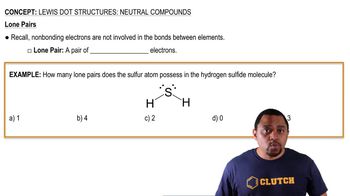
Lone Pair
A pair of valence electrons not shared with another atom and not involved in bonding.
Central Atom
The atom in a molecule that is bonded to multiple other atoms, often the least electronegative.
Noble Gas
Elements in group 18 of the periodic table, known for having full valence electron shells.
Halogens
Elements in group 17 of the periodic table, typically forming single bonds in molecules.
Nonbonding Electrons
Electrons in an atom's valence shell that are not involved in forming bonds.
Stability
The tendency of a molecule to maintain its structure and resist changes in its electron configuration.
Helium
A noble gas with a full valence shell of two electrons, serving as a model for hydrogen's electron configuration.
 Back
Back
 Back
Back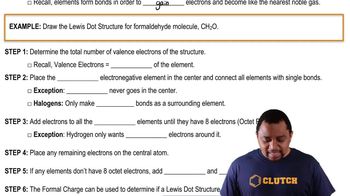
 05:56
05:56