Skip to main content
General Chemistry
My Course
Learn
Exam Prep
AI Tutor
Study Guides
Textbook Solutions
Flashcards
Explore
My Course
Learn
Exam Prep
AI Tutor
Study Guides
Textbook Solutions
Flashcards
Explore
Back
Law of Multiple Proportions definitions
You can tap to flip the card.
Law of Multiple Proportions
You can tap to
flip the card.
👆
Law of Multiple Proportions
Describes how elements combine in simple whole number ratios to form different compounds.
Track progress
Control buttons has been changed to "navigation" mode.
1/10
Related practice
Recommended videos
Guided course
03:32
Law of Multiple Proportions
Jules
Terms in this set (10)
Hide definitions
Law of Multiple Proportions
Describes how elements combine in simple whole number ratios to form different compounds.
John Dalton
An English chemist who formulated the Law of Multiple Proportions in 1804.
Atomic Mass
The mass of an atom, typically expressed in grams per mole, used to calculate mass ratios.
Nitrogen Monoxide
A compound with one nitrogen and one oxygen atom, represented as NO.
Nitrogen Dioxide
A compound with one nitrogen and two oxygen atoms, represented as NO2.
Periodic Table
A tabular arrangement of elements used to find atomic masses for calculations.
Mass Ratio
The ratio of the mass of one element to another in a compound.
Whole Number Ratio
A ratio that results in a whole number, confirming adherence to the law.
Compound
A substance formed when two or more elements chemically combine.
Element
A pure substance consisting of only one type of atom.
 Back
Back
 Back
Back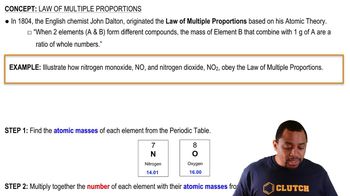
 03:32
03:32